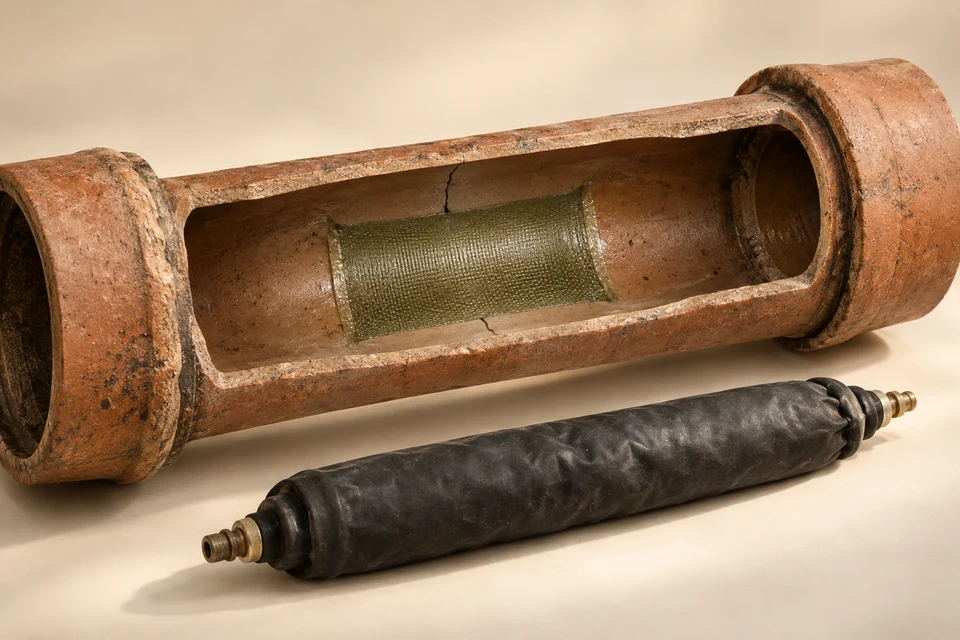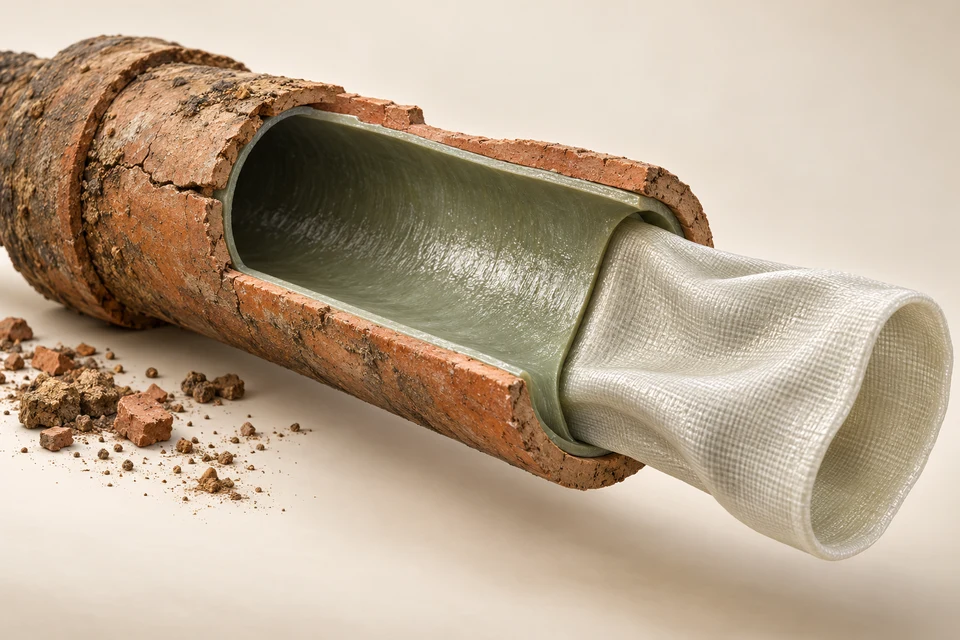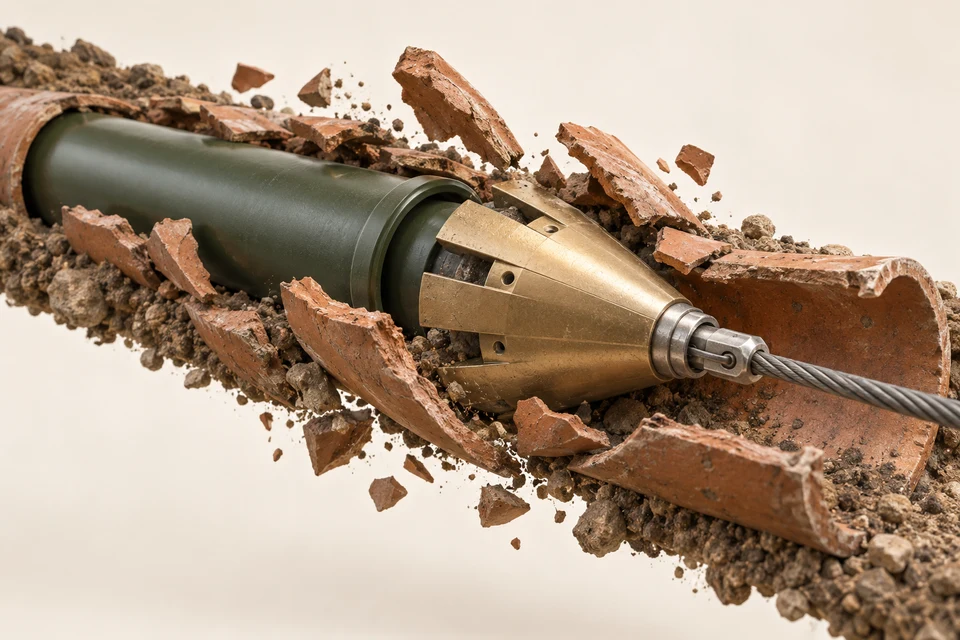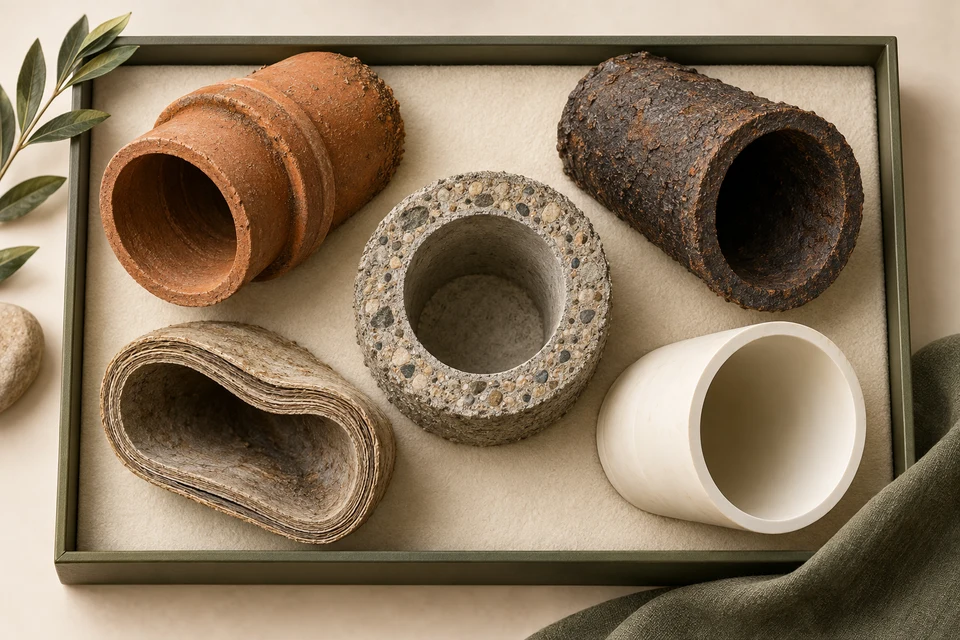
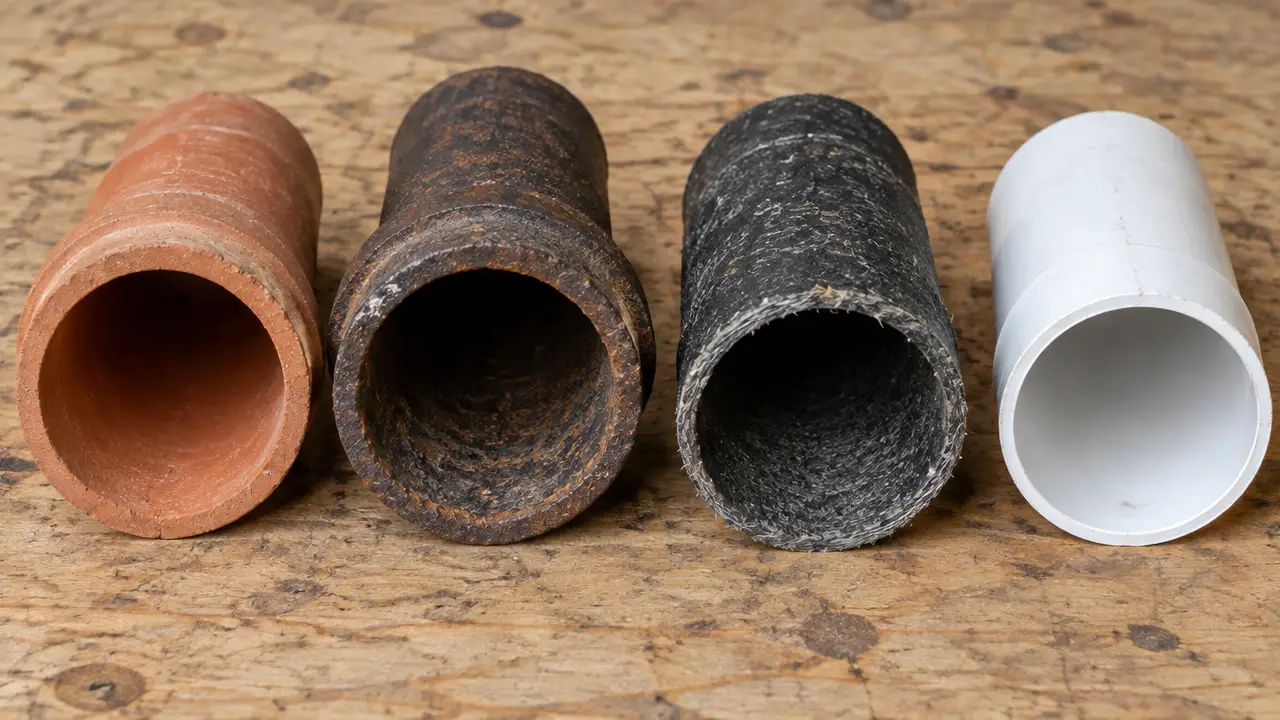
The host pipe's material shapes the repair. Vitrified clay fails at its joints and usually lines or bursts well. Cast iron corrodes and scales, and lines well once descaled if enough wall remains. Concrete lines or bursts depending on condition. Bituminous fibre (Orangeburg) often deforms and may be too far gone to line. ABS and PVC tend to have isolated faults that suit spot repairs.
- Clay: joints admit roots; a full liner seals them all, and bursting handles broken clay.
- Cast iron: descaling comes first, and thin or rotted walls change the plan.
- Orangeburg fibre: round sections may line; flattened or blistered pipe points to bursting or replacement.
- Plastic: faults are often single events such as a crack or an offset, well suited to a sectional liner or a spot dig.
- In Calgary, City data shows clay tile common in 1960s and 1970s service lines and PVC dominant from the 1980s, on the City side.
01 /Why does the pipe material matter for a trenchless repair?
Because materials fail in different ways, and each repair method has its own demands on the host pipe. A liner needs a round, clean wall to press against; a bursting head needs a pipe that will fracture; a sectional liner needs sound pipe either side of a single fault; grouting needs sound pipe with leaking joints. The material tells you which of those conditions is likely before the camera confirms it.
| Material | Typical failure | Often discussed | Watch for |
|---|---|---|---|
| Vitrified clay | Roots and leaks at joints, cracks, offsets | Full liner; bursting if broken | Roots at every joint, not just the one found |
| Cast iron | Corrosion, scale, cracks, rotted invert | Descale, then line | Wall too thin to descale; rotted bottom |
| Concrete | Corrosion, joint leaks, cracks | Line if round; burst if unreinforced and broken | Reinforced concrete resists bursting |
| Bituminous fibre (Orangeburg) | Blistering, flattening, collapse | Bursting or replacement | Deformation that stops a liner seating |
| ABS or PVC | Cracks from loads, offsets, sags, joint failure | Sectional liner or spot dig | Sags from poor bedding |
02 /How is vitrified clay repaired without digging?
Vitrified clay, called clay tile in Calgary's data, is hard, chemically resistant and brittle. The pipe itself often lasts; its joints do not. Older clay was joined with mortar or early gaskets, and each joint, spaced every metre or so along the line, is a gap that roots can find and water can leave through. Clay also cracks under point loads and shifts at joints with ground movement.
- Roots at one or two joints of otherwise clean clay: sectional liners after root cutting, with the understanding that other joints share the same age.
- Roots or leaks at many joints: a full-length liner seals every joint at once, which is usually better value than several sections.
- Broken, cracked-through or partly collapsed clay on a straight run: bursting, because clay fractures readily.
- A belly or collapse in clay: a dig at that spot, then lining or bursting for the rest.
The Spot Repair or Full Liner? planner treats clay as old jointed pipe and calls two or more sections a close call for exactly this reason.
03 /What about cast iron?
Cast iron is common inside houses of the 1950s and 1960s and in some inner-city laterals. It corrodes from the inside, building up tuberculation, rust nodules that narrow the pipe and catch debris, and it can crack along its length or lose its invert, the bottom of the pipe, where water has run for decades. It is strong but, once badly corroded, thin.
- Camera first
Assess scale, cracks and whether the invert is intact.
- Descale carefully
Remove tuberculation back to sound metal with suitable heads, without holing thin walls.
- Camera again
Confirm the wall is clean and still continuous.
- Line
A full liner, or sectional liners over isolated cracks, once the wall will support it.
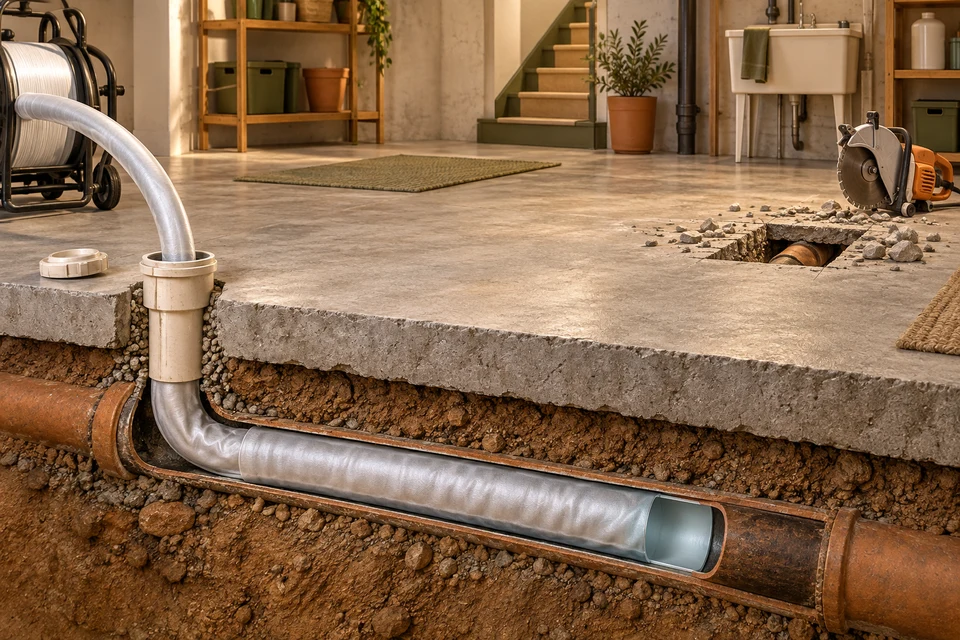
If descaling reveals missing sections or a rotted-through bottom, those lengths are usually replaced by excavation, and the rest lined. Cast iron also bursts, though its strength calls for suitable heads; that detail belongs to sister site PipeBursting.ca. Under a basement floor, cast iron repairs are covered in trenchless repair under a basement slab.
04 /Can Orangeburg pipe be lined?
Sometimes, but often not. Bituminous fibre pipe, widely known by the trade name Orangeburg, was made of wood fibre and pitch and used for some laterals in the mid-twentieth century. With age it softens, blisters and deforms, flattening into an oval or collapsing under the soil load. A liner needs a round host to seat against; a flattened fibre pipe may not give it one, and aggressive cleaning can damage the pipe further.
Where fibre pipe is still round on camera, a liner may be possible, but many installers treat it as a candidate for bursting or replacement. Fibre crushes rather than shatters, which bursting heads handle. The trenchless fit checker does not ask for material, but the spot-repair planner flags fibre and asks whether it can be lined at all.
05 /How are concrete and plastic laterals repaired?
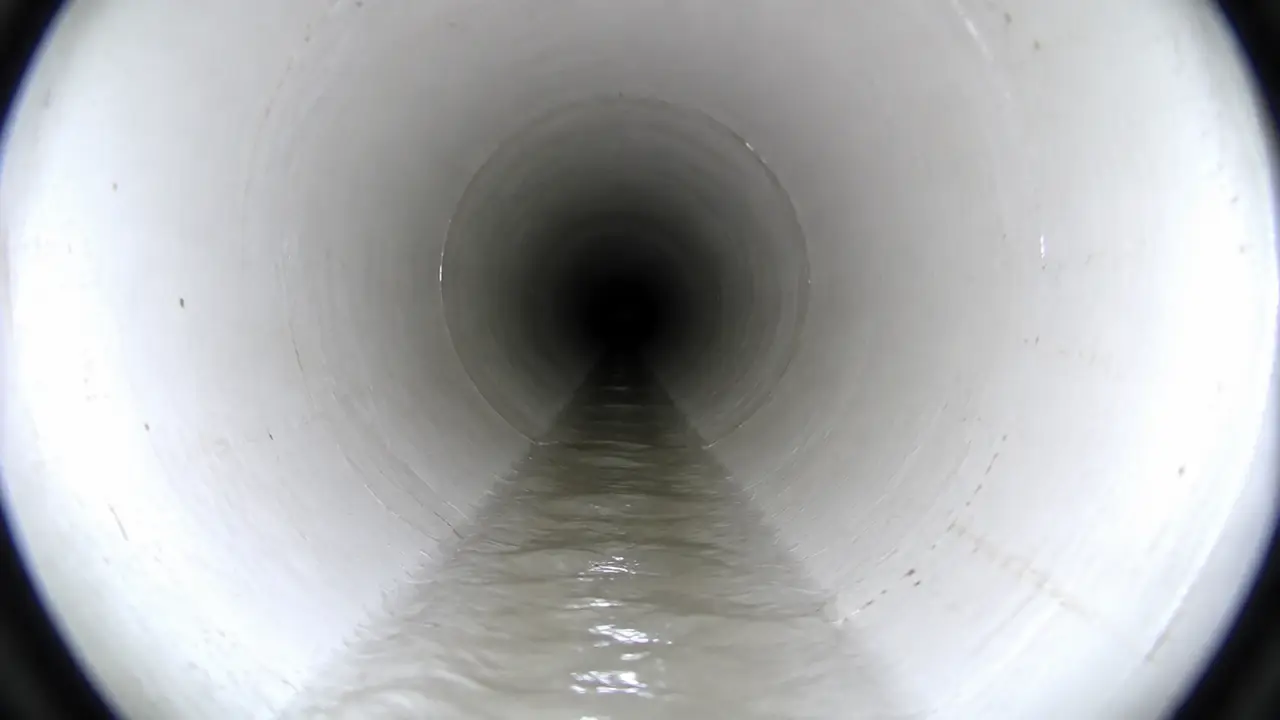
Concrete laterals are less common in houses but appear in some areas and on larger services. They can corrode, crack and leak at joints. Round concrete pipe with joint leaks or cracks lines well; unreinforced concrete that has broken up can often be burst, while reinforced concrete resists bursting and may point to lining or replacement.
ABS and PVC laterals, standard from roughly the 1980s onward, rarely fail along their whole length. Their faults tend to be single events: a crack where a heavy load crossed, an offset where the ground moved, a joint that separated, or a sag where the bedding settled. Those suit a sectional liner or a single spot dig. A sag in plastic pipe is a grade problem like any other and needs digging; see trenchless sewer belly repair.
06 /What mixed-material laterals mean for the repair
Many laterals are not one material. A house may have cast iron inside the foundation, clay from the foundation to the property line, and PVC where a previous repair spliced in a section. The City side may have been relined or replaced separately. Each change of material is a joint, often with a transition coupling, and a common place for an offset or a leak.
- A liner can usually run through a material change if the bore is similar and the transition is smooth.
- A step in diameter at the transition may need a liner system that can handle it, or a liner in two parts.
- Bursting through a plastic repair section in the middle of clay may need a splitting head or a pit at that point.
- A camera report should name each material and where it changes, by distance.
The job sequence for any of these is in how trenchless sewer repair works.
07 /What does Calgary's data say about materials?
The City of Calgary publishes the material and installed date of the City-owned portion of each residential sanitary service line, from the main to the property line. A HAUSE summary of that dataset, fetched in September 2026, counts 367,397 service lines: about 66.5% PVC, 20.2% coded TIL (generally read as clay tile), 3.3% cast iron and 1.1% already coded CIPP, with a citywide median install year of 1995.
The City's own description warns that the material on private property can be different and could have been installed at a different time, so the data is a clue to your era, not a diagnosis. Community-by-community detail, including where the City side has been relined, is in the Calgary guide. Costs for each repair are on the trenchless sewer repair cost page, and you can send your footage to the HAUSE Sewer desk for a view on your material.
FAQQuestions people ask
Can clay sewer pipe be lined?
Yes, it is one of the most commonly lined materials. Roots must be cut out first, and a full liner seals every joint, which is where clay usually fails.
Is it worth lining old cast iron?
Often, if descaling leaves a continuous, sound wall. Sections with a rotted-through bottom or missing pieces are usually replaced by excavation first.
Should Orangeburg pipe be replaced rather than lined?
Frequently. Fibre pipe that has flattened or blistered may not give a liner a round host. Round sections may line; ask the installer to confirm on camera.
Do plastic sewer lines need trenchless repair?
Usually only at a single fault such as a crack, offset or separated joint, which suits a sectional liner or a spot dig. Sags in plastic pipe need digging.
How do I find out what my sewer pipe is made of?
A camera inspection shows it. In Calgary, City open data gives the material of the City-owned portion as a clue, but the private side may differ.
NETWORKGo deeper across the HAUSE Sewer network
Sewer pipe materials by construction era, and what each looks like on camera
Sewer pipe materials by era in Canadian homes: clay, cast iron, Orangeburg, concrete, ABS and PVC, how each one fails and what it looks like on camera.
PipeCleaning.caPipe cleaning methods compared, method by method
Pipe cleaning methods compared: snaking, hydro jetting, descaling, chain knockers, enzymes and chemicals — what each removes, and which pipes each can harm.
SewerRoots.caHow tree roots get into sewer pipes
How tree roots get into sewer pipes: vapour leaks at joints, the soft backfill trench, and why clay and concrete laterals fail first, with depth and fixes.