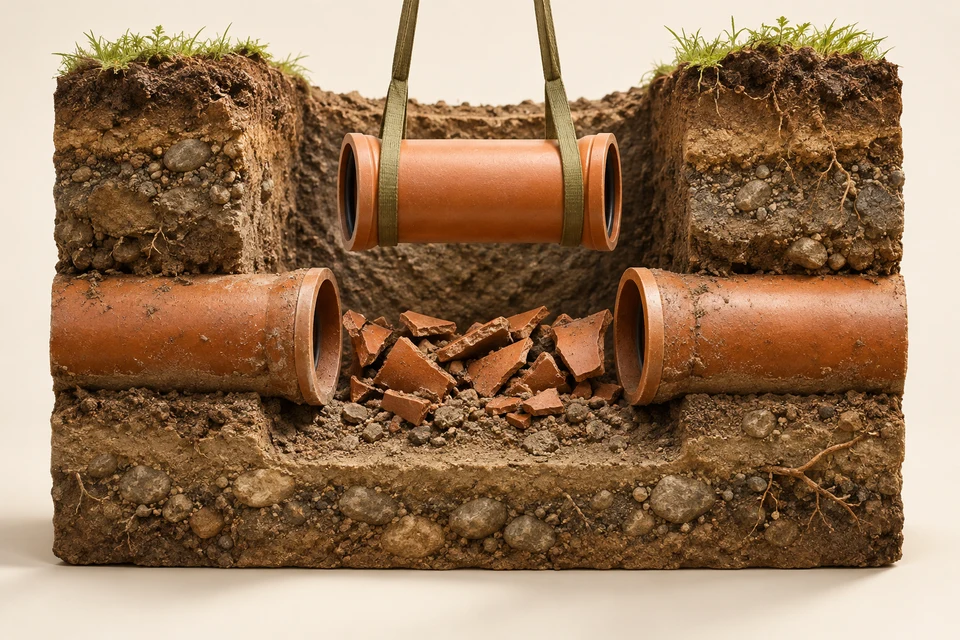
Excavation is usually the right call when the sewer pipe is collapsed, has a belly that holds water, has an offset the camera cannot pass, or when a short run under open lawn makes digging cost-competitive. Many jobs combine one small dig with trenchless work on the rest of the line, so needing a dig rarely means trenching the whole yard.
- No trenchless method corrects grade or passes a true blockage; a dig does both.
- A hybrid repair — dig one spot, line or burst the rest — is common and should be priced section by section.
- Short, shallow runs under lawn can be cheaper to dig than to line.
- Before any digging in Alberta, request utility locates at least three full working days ahead; your own sewer line needs a private locate.
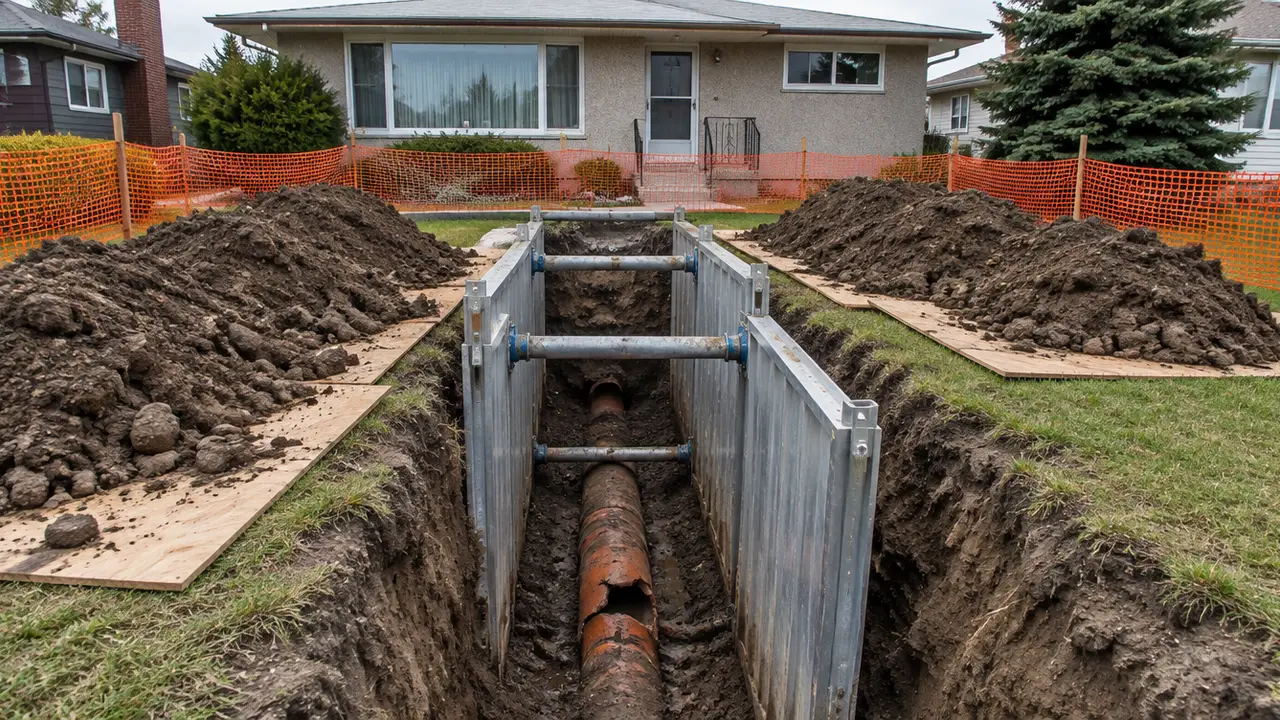
- Trenches deeper than about 1.2 m generally need a protective system, which is part of why depth drives cost.
01 /Which three conditions can trenchless methods not fix well?
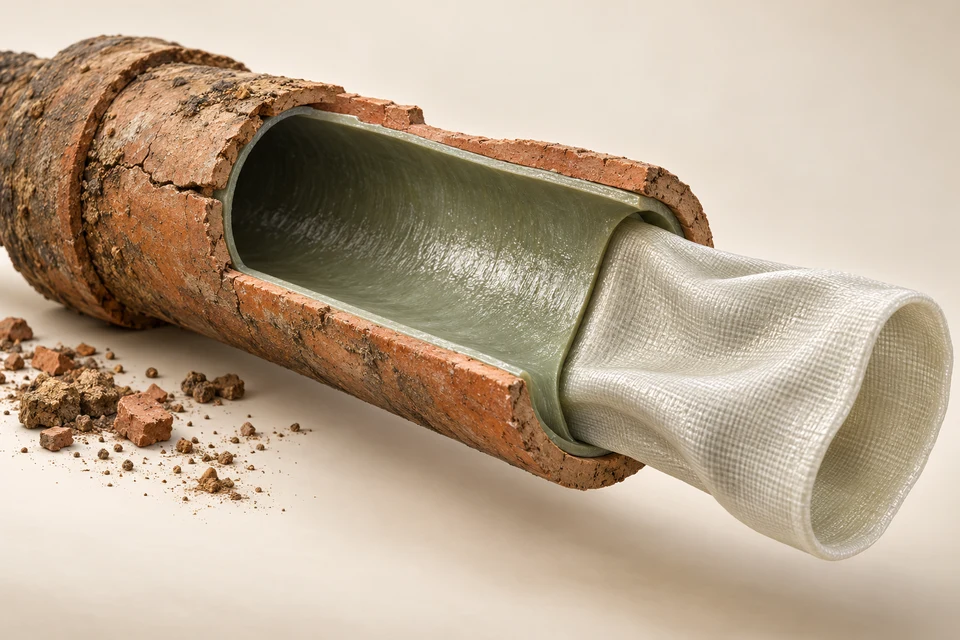
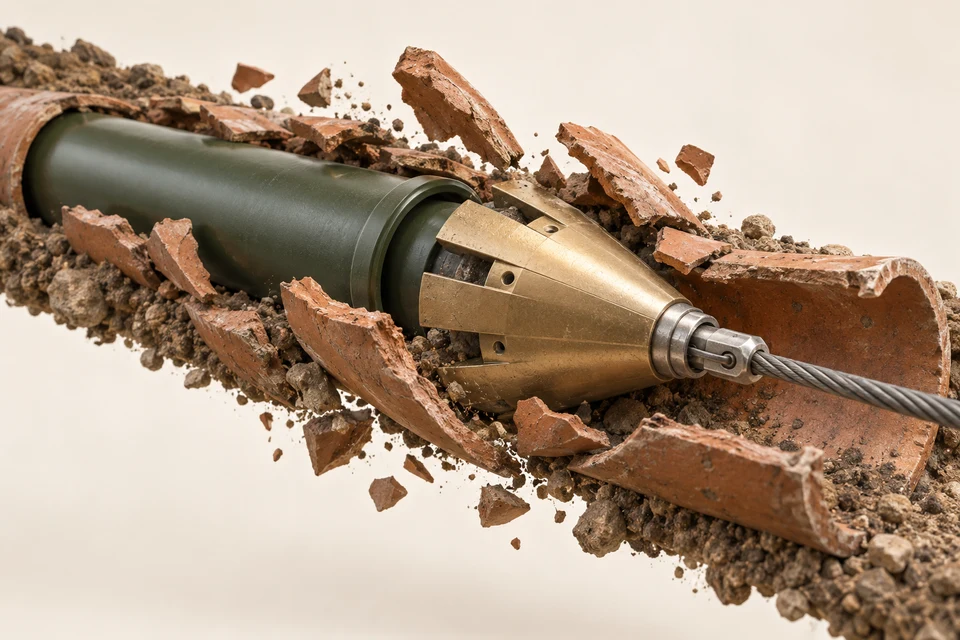
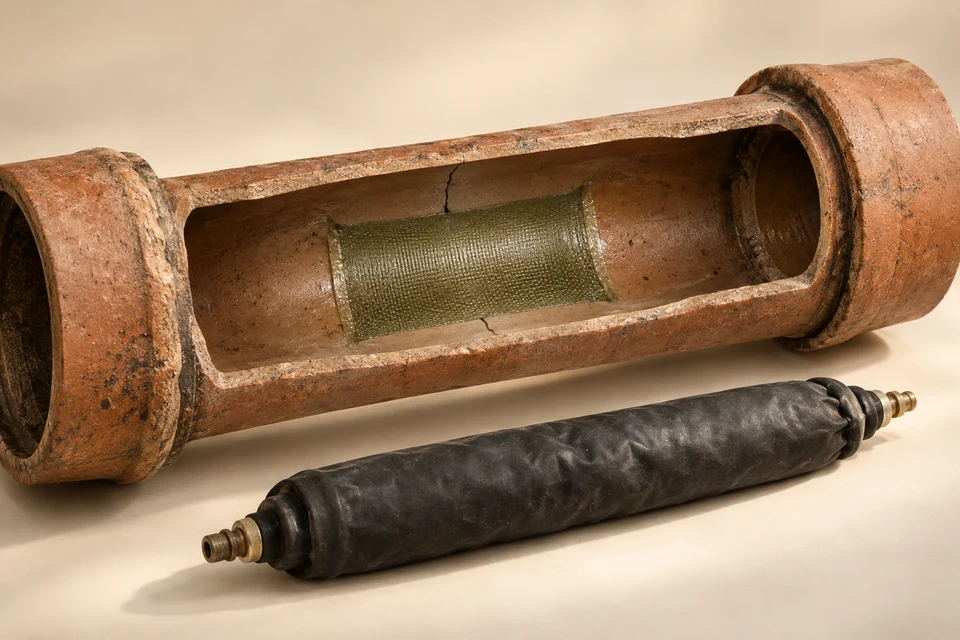
Every trenchless repair works inside the path of the old pipe. A liner is shaped by it, and a bursting head follows it. That makes three conditions hard or impossible to solve without exposing the pipe.
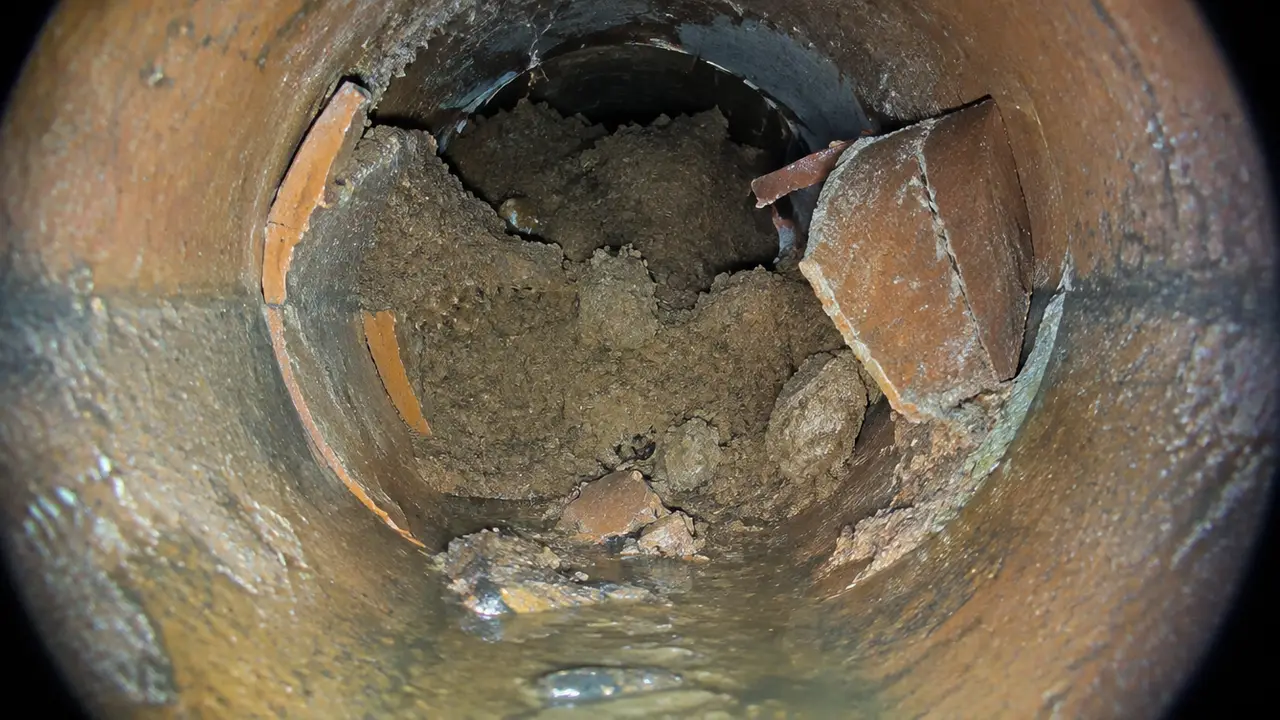
- Collapse. There is no open path for a liner, and a bursting head may stall or wander at a crushed section. The collapsed length is dug out and replaced.
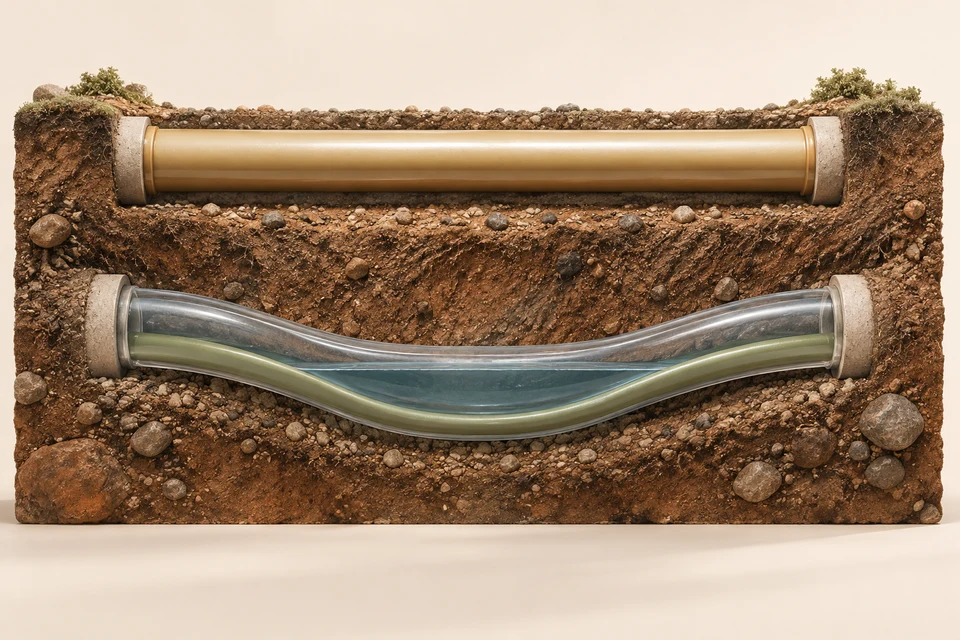
- Belly. Both lining and bursting follow the existing grade, so standing water and the buildup it causes return. Only relaying the pipe on proper bedding fixes the slope.
- Severe offset. When sections have shifted far enough to block the camera, the pipe usually needs to be exposed and realigned. A liner cannot be inverted past a blockage it cannot see beyond.
These are the same three conditions the original version of this site drew as the cases where neither lining nor bursting fits, and they are still the right starting point. The trenchless fit checker keeps excavation at Discuss first for all three, whatever sits above the line.
02 /When is digging simply the cheaper option?
Sometimes the pipe could be lined, but digging costs less or gives a better result. That usually happens when the run is short, the pipe is shallow, the ground above is open lawn, and there is nothing expensive to restore. A dig also installs new pipe on new grade and lets the installer see exactly what they are connecting to at each end.
| Factor | Favours digging | Favours trenchless |
|---|---|---|
| Length | Short run, roughly under 15 m | Long run, especially over 30 m |
| Depth | Shallow | Deep, where a trench needs shoring |
| Surface | Lawn or open ground | Driveway, patio, mature trees, an addition |
| Grade | Belly or wrong slope | Grade is fine |
| Access | No cleanout and none can be added | Usable cleanout or pit locations |
| Pipe | Collapsed, crushed, missing sections | Round, passable, local defects |
These are tendencies, not rules. The only reliable way to know is to price both from the same camera footage. The fit checker raises the dig option when your run is under 15 m with lawn above, and lowers it for long runs and hard surfaces.
03 /What is a hybrid repair, and why is it so common?
A hybrid repair digs only where a trenchless method cannot work and uses trenchless methods everywhere else. A contractor might open one pit to replace a collapsed section or relay a belly, then line the lateral either side from the cleanout, or burst the remaining length using the same pit as a launch point. On older laterals with one grade failure and many root joints, it is often the plan that fixes everything for the least disturbance.
Ask for the plan to show each section's method, length and price separately. That lets you see what the dig costs on its own, compare it with the price of trenching further, and check that the liner ends lap onto the new pipe properly. If your defect list mixes linable faults with a belly or collapse, Spot Repair or Full Liner? prices the digs into both liner plans.
04 /What happens during a sewer excavation?
- Locates and permit
Public utilities are marked through the provincial locate service, private lines are traced, and a permit is obtained where required.
- Excavation
Machine digging to near the pipe, then hand work around it; deeper trenches are shored or boxed.
- Cut out and replace
The failed section is removed and new pipe, commonly PVC, is joined to sound pipe with shielded couplings.
- Bedding and grade
The new pipe sits on compacted bedding at a checked slope, so the belly does not come back.
- Inspection and video
A camera run, and an inspection where the permit calls for one, before the pipe is covered.
- Backfill and restoration
Backfill in compacted layers, then topsoil and sod, or concrete and pavers as the contract says.
05 /What must happen before any digging in Alberta?
Alberta requires utility locates before ground disturbance. Utility Safety Partners asks homeowners and contractors to place a request at least three full working days before starting, and to expose any marked line with hand tools within one metre either side of the marks. Its homeowner guidance also states that customer-owned lines, including water and sewer service lines, are not registered with it — so your own lateral is traced with a camera sonde or a private locator.
Work on the public side of the property line may involve your municipality. In Calgary, the City owns the sanitary service from the main to the property line and the homeowner owns the rest, according to the City's open-data description of its service lines; the City also inspects connections and keeps a list of approved indemnified contractors for work on utility connections. Confirm who is responsible for each part of the line, and who may work on it, before a shovel goes in.
06 /What does a dig cost, and what drives it?
As 2026 planning estimates, a single excavated spot repair typically quotes about $3,500 to $9,000 CAD when it is under about 2.5 m deep and under lawn, and $7,000 to $16,000 when it is deep or under concrete or asphalt. A repair under a basement slab runs about $4,000 to $12,000. Open-cut replacement of a 15 to 25 m lateral is about $12,000 to $35,000 or more.
Depth and surface dominate: every extra half metre means more digging, and every square metre of concrete or pavers must be rebuilt. Frozen ground in a Calgary winter slows excavation and adds cost, which is one reason non-urgent digs are often booked for spring or fall. Full line items are on the trenchless sewer repair cost page, and repairs under a basement floor are covered in trenchless repair under a basement slab.
07 /What should I ask a contractor who recommends digging?
- Which defect on the footage makes a dig necessary, and at what distance?
- Could the rest of the line be lined or burst from the same pit?
- How deep and how wide is the dig, and will it be shored?
- How will bedding, slope and couplings be checked before backfill?
- What restoration is included, and what is excluded?
- Who books locates, pulls the permit and deals with the municipality if the city side is involved?
- Will I get a camera video of the new section before it is covered?
A good recommendation to dig points at a specific defect on the footage. If it does not, get a second opinion; the HAUSE Sewer desk can look at your video. The other side of this decision is in when CIPP sewer lining fits and when pipe bursting fits.
FAQQuestions people ask
Does needing a dig mean trenching my whole yard?
Rarely. Most digs on house laterals are a single pit at the fault, with the rest of the line lined or burst. Ask for a hybrid plan priced section by section.
Can I line over a belly to save digging?
You can, but the belly stays and keeps holding water and solids inside the new liner. Recurring blockages at that spot are the usual result.
Is digging ever better than trenchless on a long line?
Sometimes, when the grade is wrong along much of the line or the pipe is collapsed in several places. Otherwise long runs usually favour trenchless because of restoration costs.
Who pays if the problem is on the city side?
In Calgary the City owns the service from the main to the property line. If the camera shows the fault on that side, call 311 before any work is done on it.
Can a dig be done in winter in Calgary?
Yes, but frozen ground makes excavation slower and more expensive, and restoration may wait for spring. Urgent failures are still repaired in winter.
NETWORKGo deeper across the HAUSE Sewer network
Sewer line locating and depth: how the mark on your lawn is made
How sewer line locating and depth readings work: the sonde, the hand-held locator, peak and null readings, marking, accuracy, and calling before you dig.
SewerQuotes.comSewer line repair cost: what a spot repair should cost
Sewer line repair cost in Canada for 2026: spot repair and sectional liner planning ranges in CAD, what drives the price, and when a repair beats full replacement.
SewerJetting.caWhat is hydro jetting in oil and gas, and how does it differ from sewer jetting?
What is hydro jetting in oil and gas? How industrial hydro blasting differs from sewer jetting in pressure, tools and safety, plus hydrovac and sewer careers.