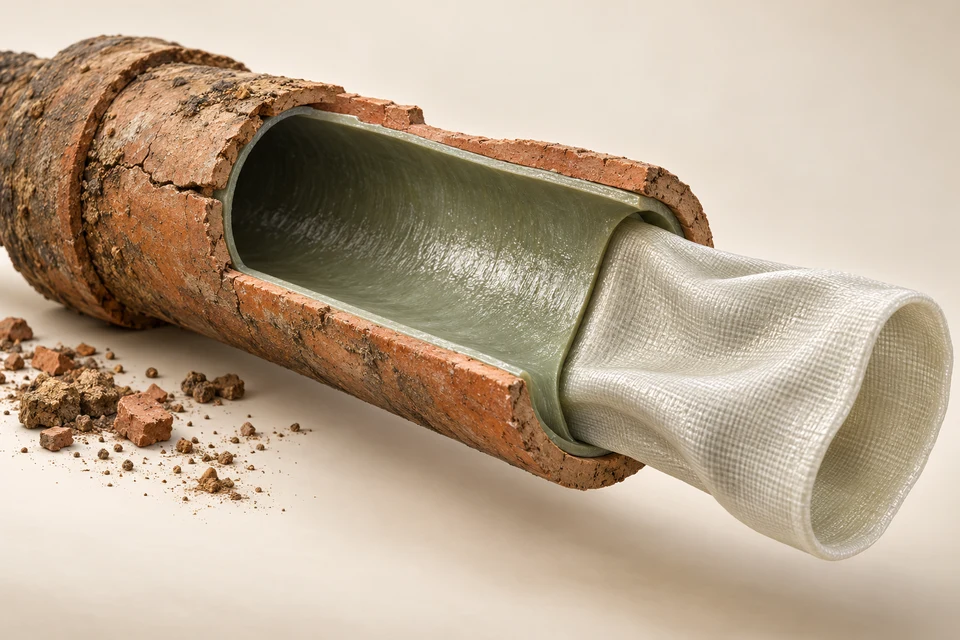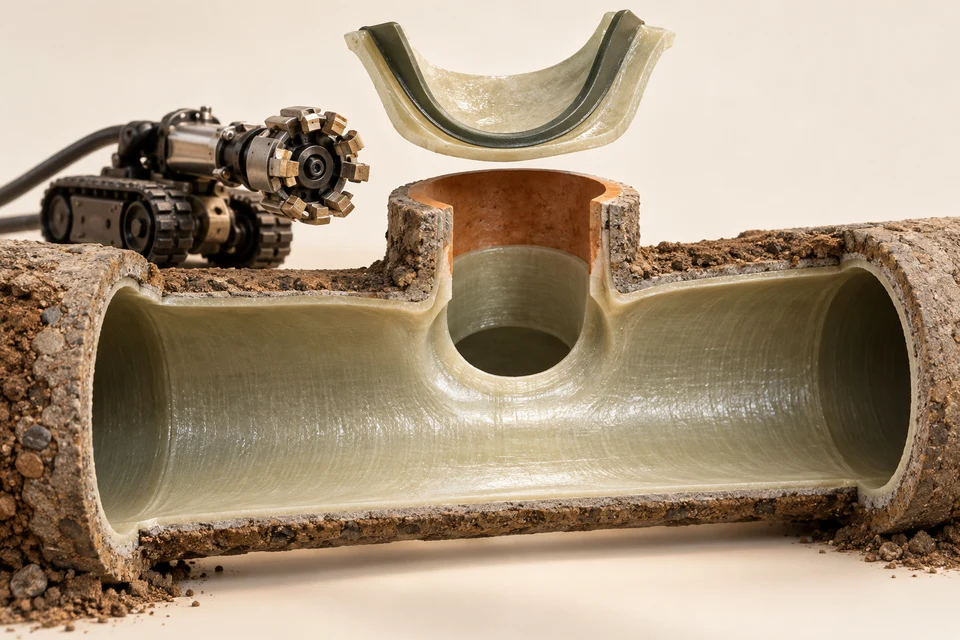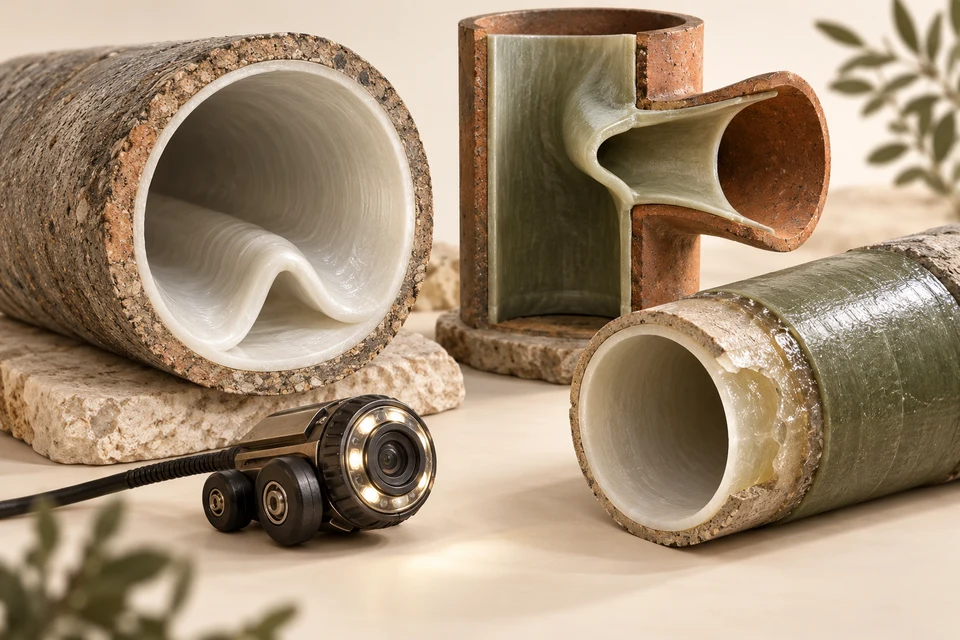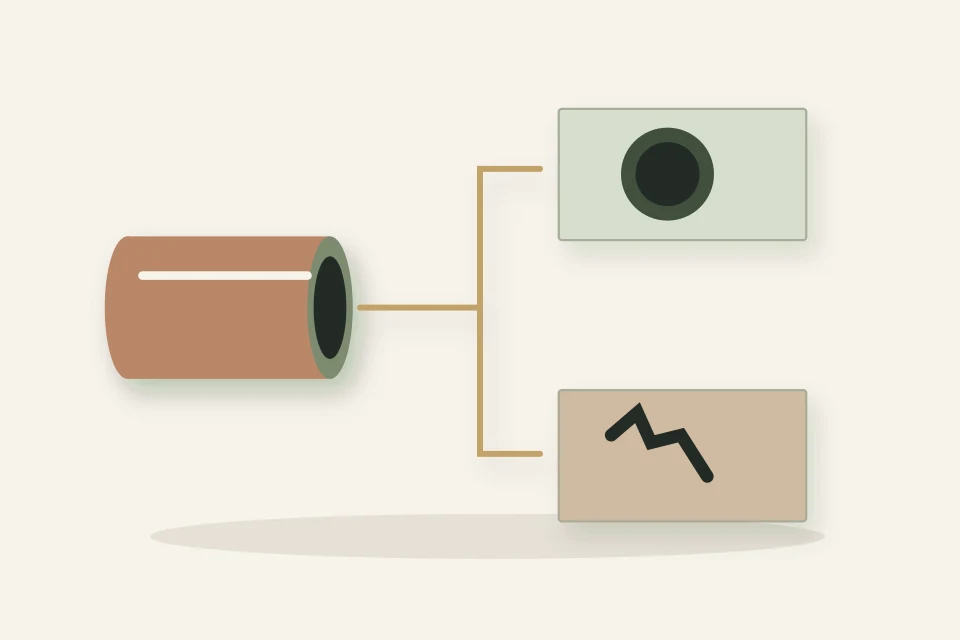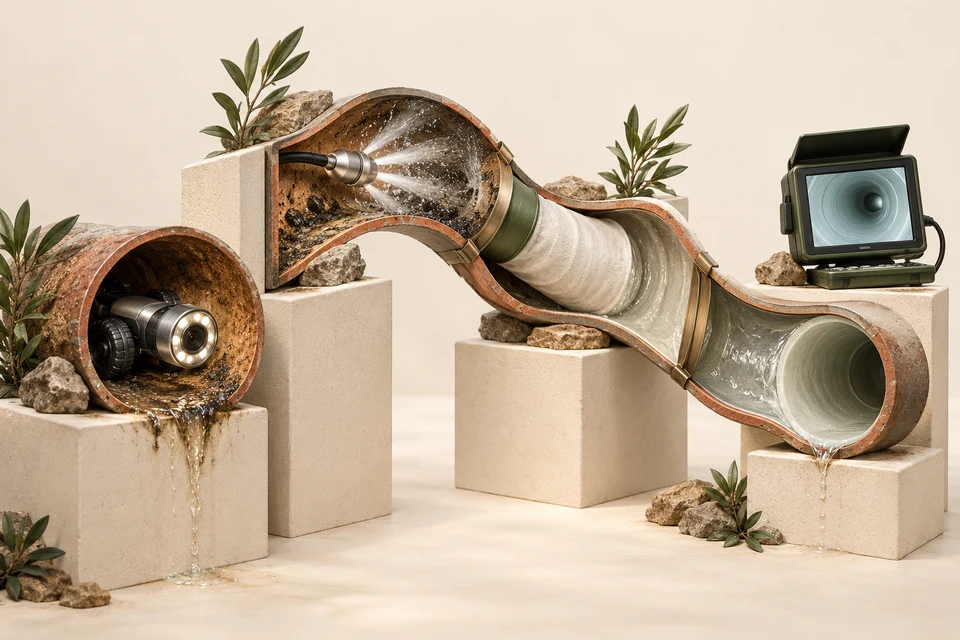
Trenchless sewer repair works by fixing the pipe from an access point instead of trenching along it. The line is recorded on camera and located, cleaned back to sound pipe, then repaired from inside with a sectional or full-length liner, or replaced along its path by bursting from small pits. Branch connections are reopened, and a final camera run proves the result.
- The repair is only as good as the inspection and cleaning that come before it.
- Access is usually an existing or new cleanout; bursting needs a pit at each end.
- Liners are cured in place and cannot be inspected any way but by camera, so the final video matters.
- A typical house lateral repair takes one working day on site, sometimes two; drains are out of use for part of it.
- Every step is a question you can ask before signing.
01 /Step 1: How is the line inspected and located?
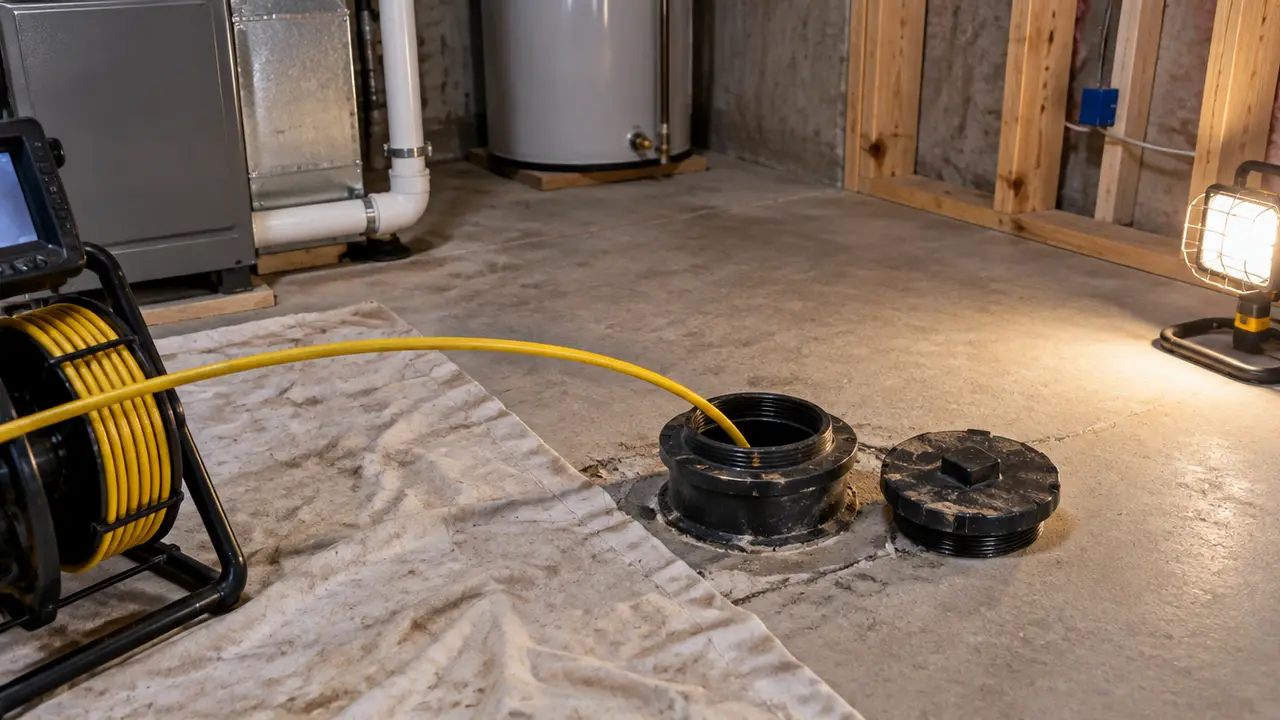
Every trenchless repair starts with a recorded camera run from a cleanout or another access point to the city connection. The footage counter logs each defect by its distance along the pipe, and a sonde, a small transmitter in the camera head, lets a locator on the surface mark the route and depth. That turns a video into a map: roots at 4.2 m, a crack at 9.8 m, a branch at 12.1 m, depth at the property line.
Two details decide whether that inspection is good enough to plan a repair: the whole line must be seen, and the video must be yours to keep. A report that says roots with no distances, or footage that stops short of the main, is not a basis for choosing between a sectional liner and a full one. Defect coding and report reading are covered in depth on sister site SewerInspector.ca.
02 /Step 2: What happens in the diagnosis and method choice?
The footage is turned into a written diagnosis: pipe material and diameter, each defect and its severity, any belly or offset, the access points, the connections along the run, and anything above ground that constrains the work. From that the installer proposes a method and, if they are doing it properly, explains why the others were ruled out.
| If the footage shows | The usual conversation |
|---|---|
| One or two isolated faults in sound pipe | Sectional liners |
| Faults spread along old jointed pipe | A full-length liner |
| Pipe too broken or too small to line, straight run | Pipe bursting |
| A belly, collapse or blocking offset | A dig at that spot, then trenchless for the rest |
| Groundwater getting in at otherwise sound joints | Joint grouting, or a liner |
The trenchless fit checker walks through the same logic from six questions and lists what to ask. The written quote that follows should name the method, the materials, the lengths, the connections to reopen, the access and restoration, and what is excluded.
03 /Step 3: Why does cleaning matter so much?
A liner bonds and seats against whatever it is pressed onto. Roots left in a joint, scale left on cast iron or grease left on the invert become lumps under the liner, gaps behind it and weak points in it. Cleaning is therefore not a courtesy before the real work; it is part of the repair.
- Root cutting with a cutter head or jetter nozzle, back to the pipe wall at every root joint.
- Descaling of cast iron to remove tuberculation, taking care on thin walls.
- Jetting to flush debris, grease and loosened scale out of the line.
- A second camera run after cleaning, to confirm the wall is clean and that nothing broke loose.
Ask whether post-cleaning footage is included. It is the only way to know the liner went onto clean pipe.
04 /Step 4: How do crews get into the pipe?
Most lining jobs use a cleanout: a capped opening on the building drain inside the basement, or outside near the foundation. If the house has no usable cleanout, one is usually installed first, often in a small pit outside, and that becomes both the way in for the repair and the way in for every future inspection. Bursting needs more: a launch pit at one end, a receiving pit at the other, and a small pit at any connection that must be remade.
Access is why two quotes for the same defect can look so different. A contractor who can work from an existing basement cleanout avoids a pit; one who needs a pit outside prices the excavation and the restoration above it. As 2026 planning estimates, a new exterior cleanout typically quotes about $600 to $2,500 and an access pit about $1,500 to $4,500 plus restoration.
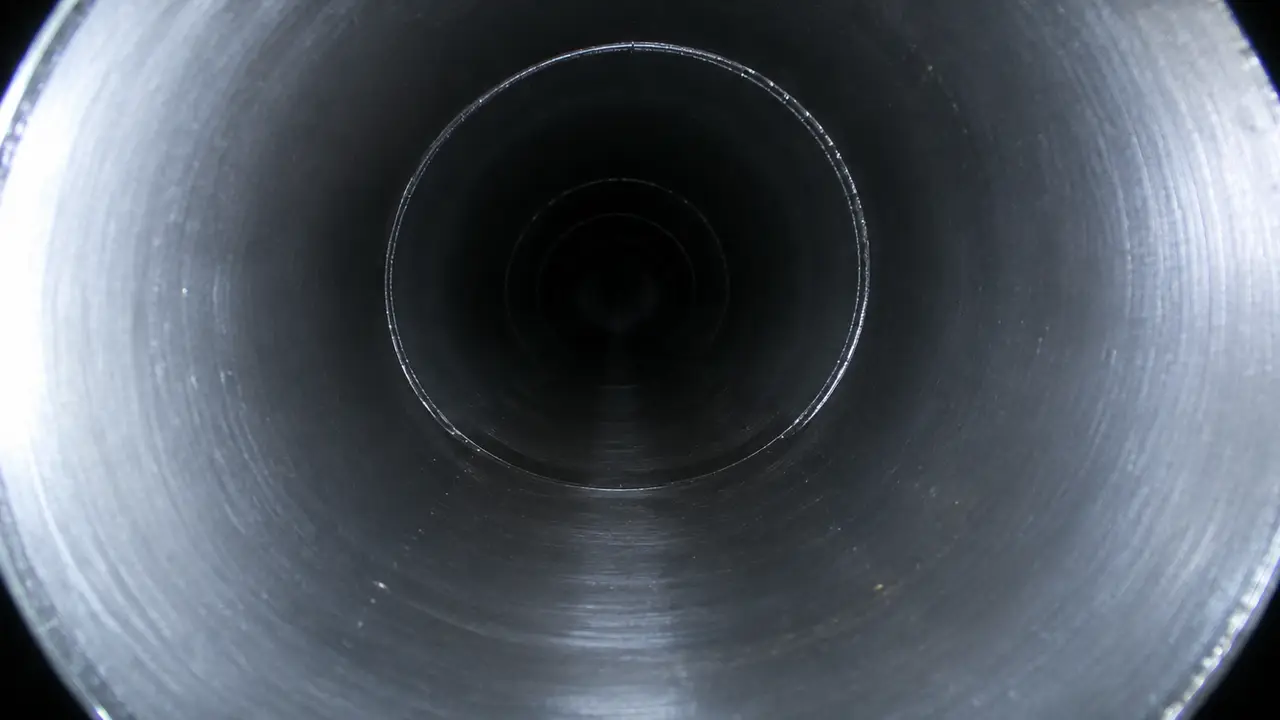
05 /Step 5: What does the repair itself look like?
That depends on the method, but in every case the flow is stopped or bypassed while the work is done, and the household is asked not to use the drains.
- Sectional liner
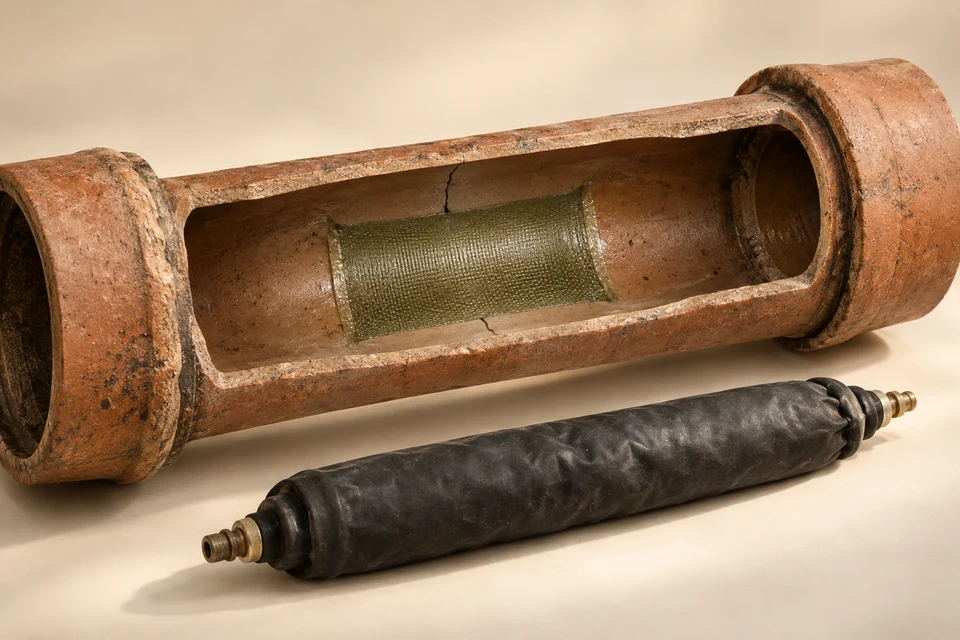
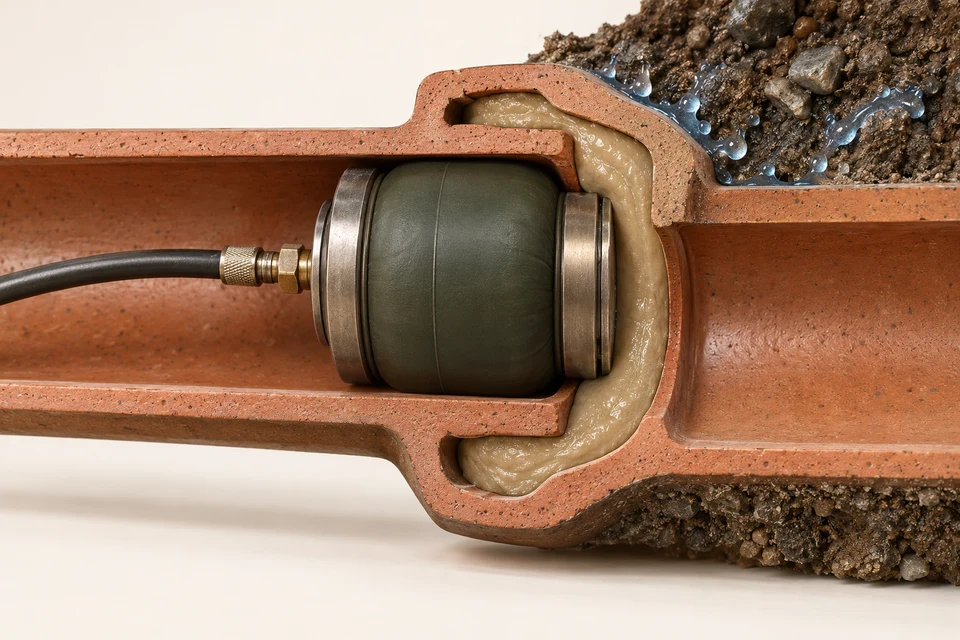
A short sleeve of resin-soaked fabric is wrapped on an inflatable packer, pushed to the defect using the camera, inflated to press the sleeve onto the wall, held while the resin cures, then deflated and withdrawn.
- Full-length liner
A resin-saturated tube is inverted by air or water pressure, or pulled in and inflated, along the whole run, then cured with hot water, steam, UV light or time.
- Pipe bursting
A head is pulled from the launch pit to the receiving pit, breaking the old pipe outward while new pipe follows; the ends are then reconnected.
- Joint grouting
A packer isolates each joint, air-tests it and injects grout where it leaks, so the grout gels in the soil around the joint.
Each method has its own guide: when CIPP sewer lining fits, sewer spot repair, when pipe bursting fits and sewer joint grouting.
06 /Step 6: How are connections reopened and the ends finished?
A full liner covers every opening in the pipe, including branch connections. The US EPA fact sheet notes that the liner dimples where a connection sits and that openings are typically reinstated with robotic cutting devices, working from inside the cured liner. On a house lateral that may be one branch or several, plus the ends where the liner meets the old pipe at the cleanout and at the main or property line.
The cut must be clean and full-sized, and the junction sealed so water cannot track between the liner and the old pipe. That junction is where lined laterals most often leak or catch roots again, which is why it has its own guide, lateral reinstatement and connection seals.
07 /Step 7: What should the final video show?
A post-repair camera run from end to end, recorded with distances. It should show a smooth liner without major wrinkles, fins or bulges, liner ends sitting where the quote said, every branch cleanly reopened, no standing water beyond any belly you were warned about, and no daylight or leaks at the ends. On a burst, it should show continuous new pipe and sound reconnections.
- Ask for the before, after-cleaning and final videos as files you keep.
- Compare the final video with the quote: lengths, ends, connections.
- Store it with the house records; it is what a future buyer or insurer will ask for.
Anything that looks wrong on that video is far easier to deal with before the crew leaves. What to look for is detailed in problems with trenchless sewer repair.
08 /How long does it all take, and what about permits?
For a typical house lateral, the inspection is a separate visit of an hour or two, and the repair is usually one working day on site, sometimes two when cleaning is heavy or connections are many. Drains are out of use for part of that day. Bursting adds time for pit excavation and restoration.
Permits depend on the municipality and the scope. In Alberta, plumbing permits are available through municipalities accredited under the Safety Codes Act or through agencies in non-accredited areas; in Calgary, the City issues plumbing permits and books inspections through 311 or its online account. Ask who pulls the permit, and whether an inspection will be booked, before work starts. Costs for each step are on the trenchless sewer repair cost page, and you can send your footage to the HAUSE Sewer desk for next steps.
FAQQuestions people ask
How does no-dig sewer repair work?
The pipe is inspected, cleaned and repaired from an access point, usually a cleanout, with a liner cured inside it or a new pipe pulled through it by bursting. Only the access points, if any, are dug.
How long does trenchless sewer repair take?
Usually one working day on site for a house lateral, sometimes two. The camera inspection is normally a separate, shorter visit beforehand.
Do I have to leave the house during the repair?
Usually not, but you cannot use the drains while the pipe is being worked on and the liner cures. Some resins have an odour; ask about ventilation.
Is trenchless repair done from inside the house?
Often, when there is a basement cleanout. Otherwise a cleanout is added outside, or pits are dug for bursting.
What is the most skipped step in trenchless repair?
Proper cleaning with a camera check afterwards, closely followed by the final video. Ask for both in the quote.
NETWORKGo deeper across the HAUSE Sewer network
How long a sewer scope takes, from booking to the report
How long a sewer scope inspection takes: typical time on site, what adds time, how far ahead to book, and when to expect the video and the written report.
SewerQuotes.comPipe bursting cost: trenchless sewer line replacement, priced
Pipe bursting cost in Canada (2026): trenchless sewer replacement ranges in CAD, pit and per-metre pricing, upsizing, and when it beats lining or digging.
SewerJetting.caWhat to expect on a hydro jetting visit, from arrival to camera proof
What to expect on a hydro jetting visit: access, camera inspection, nozzle choice, jetting passes, clean-up, the proof you should get and how to prepare.