This glossary defines the words that appear in trenchless sewer repair quotes, camera reports and contracts, from sectional liner and wet-out to reinstatement, annulus and test-and-seal. Each definition is written for a homeowner reading a quote, with the repair decision in mind rather than the engineering detail.
- Most confusion in quotes comes from a handful of words: sectional, full-length, reinstatement, belly and access.
- A term that names a method (CIPP, bursting, grouting) is different from one that names a defect (offset, belly, collapse).
- When a quote uses a word not listed here, ask the contractor to define it in writing.
01 /How to use this glossary
Terms are listed alphabetically below. Where a word has a sister term that means nearly the same thing, such as point liner and sectional liner, both are listed and cross-referenced. The definitions describe how the words are generally used on Canadian residential jobs; individual contractors and manufacturers sometimes use them a little differently, which is why a written scope matters.
For the decisions these words feed into, start with the trenchless fit checker or how trenchless sewer repair works. Short answers to common questions are on the trenchless sewer repair FAQ.
A–ZTerms
- Access pit
- A small excavation dug to reach the pipe where no cleanout exists, or to launch or receive equipment. It is usually far smaller than a trench but still needs locates and restoration.
- Acrylamide grout
- A chemical grout used to seal leaking sewer joints; it gels in the soil around the joint. NASSCO publishes claims about its long-term durability when mixed and applied properly.
- Annulus
- The thin space between a liner and the old host pipe. Water can travel along it if the liner is not fully bonded or its ends and connections are not sealed.
- ASTM F1216
- The ASTM International standard practice for renewing pipes by inverting and curing a resin-impregnated tube, covering 4 to 108 inch pipes cured with hot water or steam.
- Backwater valve
- A valve on the building drain with a flap that closes if sewage flows back toward the house. A liner cannot run through a working valve, so lining plans must end at it or remove and refit it.
- Bedding
- The compacted material a buried pipe rests on. Bedding washed out or poorly compacted is a common cause of a belly.
- Belly
- A section of sewer pipe that has sunk below the line's grade, where water and solids pool. Liners and bursting follow it; a dig is needed to correct it. Also called a sag.
- Branch connection
- Any point where another drain joins the lateral or building drain. Each one covered by a full liner must be reopened.
- Building drain
- The horizontal drain under or inside the house that collects from the stack and fixtures and carries waste to the foundation wall.
- Building sewer
- The pipe from the foundation wall to the municipal connection, usually called the lateral or service line.
- Bursting head
- The cone-shaped tool pulled through an old pipe in pipe bursting. It breaks the pipe outward and tows the new pipe behind it.
- Bypass
- Keeping flow out of the section being repaired, by stopping water use in a house or by pumping around the work on larger lines.
- Camera inspection
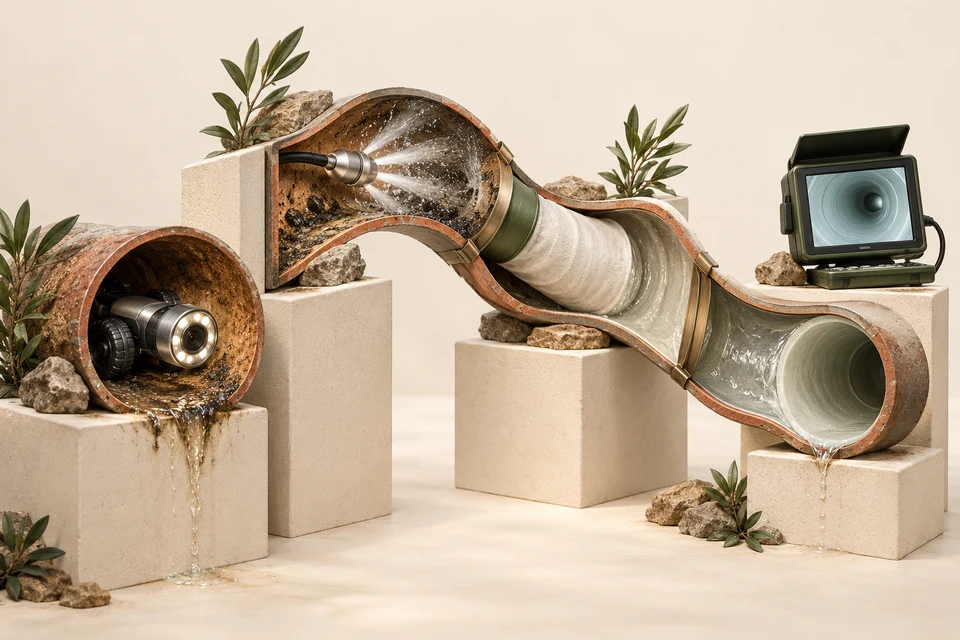
- A recorded video survey of a pipe with a push or crawler camera, with a footage counter logging defects by distance. The basis for choosing any repair.
- Cast iron
- A heavy metal drain pipe common in older houses. It corrodes and scales inside, and lines well after descaling if enough wall remains.
- CIPP (cured-in-place pipe)
- A liner made of fabric saturated with resin, put inside an old pipe and hardened in place to form a new jointless pipe. Can be full-length or sectional.
- Cleanout
- A capped opening on a drain or sewer for cleaning and inspection. It is the usual way in for a liner and for future camera runs.
- Collapse
- A section of pipe that has caved in or been crushed so there is no open path. It cannot be lined through and usually needs a dig.
- Connection seal
- A short liner, gasket or grout treatment that closes the junction between a lined pipe and a branch so water and roots cannot enter there.
- Cure
- The hardening of a liner's resin, by hot water, steam, ultraviolet light or ambient time. An incomplete cure leaves soft, weak areas.
- Cutter (robotic)
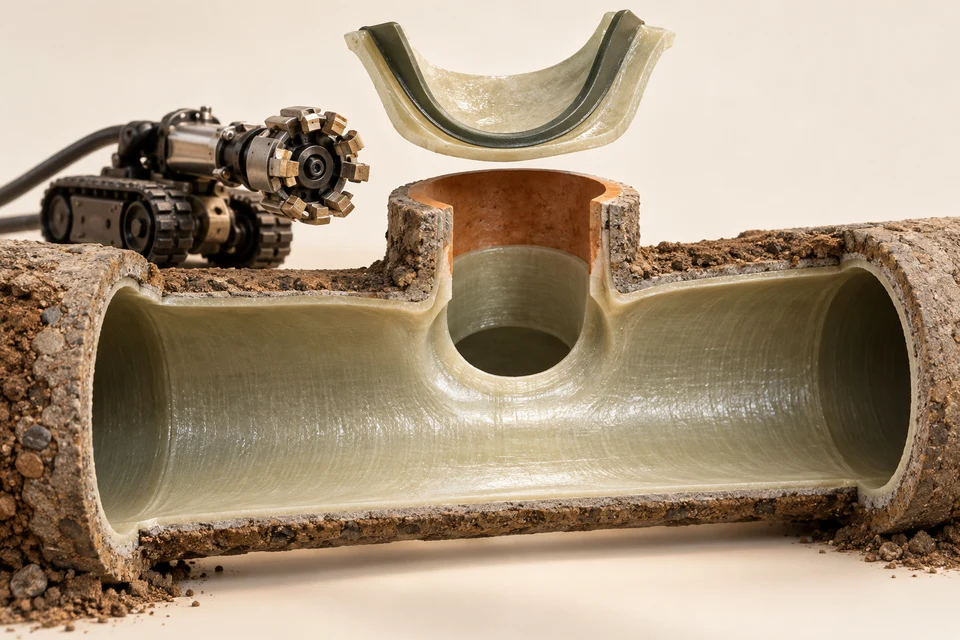
- A remote-controlled grinding tool with its own camera, used inside a cured liner to reopen branch connections and trim ends.
- Descaling
- Removing rust nodules and mineral scale from the inside of a pipe, usually cast iron, before lining.
- Dimple
- The slight bulge a liner forms over a branch opening as it cures. Crews use it to find connections to reopen.
- End seal
- A band, gasket or sealing treatment at the end of a liner that stops water tracking between liner and host pipe.
- Excavated spot repair
- Digging down to one defect, cutting out the damaged piece and coupling in new pipe on proper bedding and grade.
- Exfiltration
- Sewage leaking out of a pipe into the surrounding soil through cracks or joints.
- Fin
- A ridge of liner material standing into the flow, usually from an oversized liner or a bend. Large fins catch solids.
- Footage counter
- The distance readout on a sewer camera, measured along the pipe from the access point. Defects and connections are logged by it.
- Full-length liner
- A liner that renews the whole lateral between its ends, sealing every joint, as opposed to a sectional liner over one defect.
- Grade
- The slope of a sewer pipe toward the main. Trenchless methods keep the existing grade; only excavation changes it.
- Grouting (chemical)
- Sealing leaking joints by injecting grout that gels in the soil around them. It seals but does not strengthen the pipe.
- HDPE
- High-density polyethylene, the pipe most often pulled in by bursting. Lengths are fused into one continuous pipe.
- Host pipe
- The existing pipe a liner is installed inside, or the pipe a bursting head breaks.
- Hybrid repair
- A repair that digs only where a trenchless method cannot work, such as a belly or collapse, and lines or bursts the rest.
- Hydrophilic seal
- A gasket material that swells in contact with water, used at liner ends and connections to close gaps.
- Infiltration
- Groundwater leaking into a sewer through cracks and joints. It adds flow and can wash soil into the pipe.
- Inversion
- Installing a liner by turning it inside out along the pipe under air or water pressure, so the resin side ends up against the host wall.
- Invert
- The inside bottom of a pipe, where flow runs. In old cast iron it is often the first part to corrode through.
- Joint
- Where two lengths of pipe meet. In old clay and concrete, joints are where roots and leaks usually start.
- LACP
- NASSCO's Lateral Assessment and Certification Program, a coding system for recording defects in laterals on camera.
- Lateral
- The sewer pipe from a building to the municipal main. In Calgary the City owns the part from the main to the property line.
- Launch pit
- The excavation where a new pipe enters the ground in pipe bursting, opposite the receiving pit.
- Locate
- Marking the position of buried utilities before digging. In Alberta, public utilities are located through Utility Safety Partners; private sewer lines need a private locate.
- Offset joint
- A joint where two pipe lengths have shifted out of line. Minor offsets can often be lined; severe ones that block the camera usually need a dig.
- Open cut
- Replacing a pipe by digging a trench along its route. It allows new pipe on new grade but requires restoring everything above.
- Orangeburg
- A trade name for bituminous fibre pipe, made of wood fibre and pitch. It deforms and blisters with age and may be too far gone to line.
- Packer
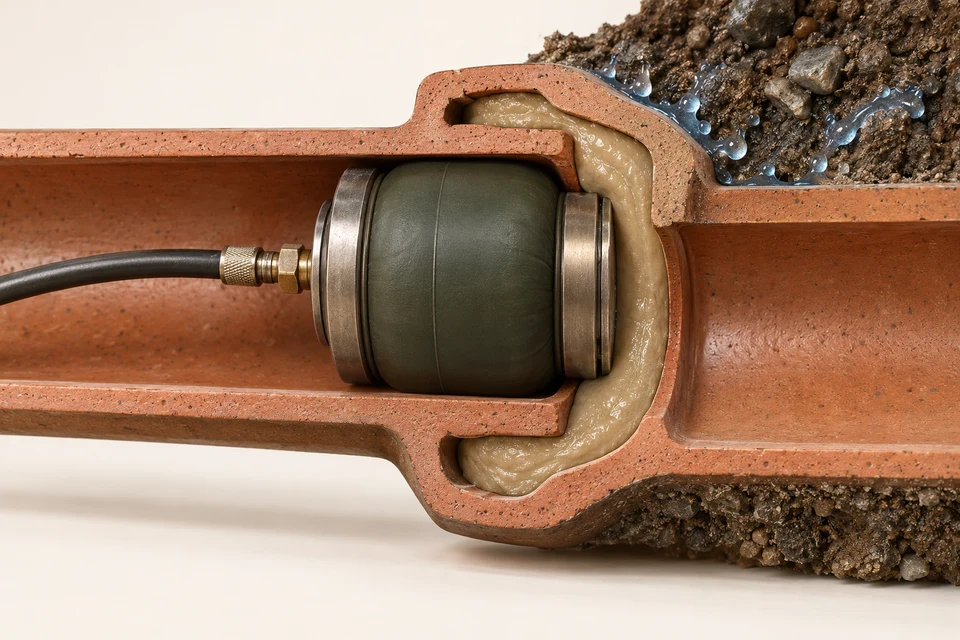
- An inflatable tool used inside a pipe, either to press a sectional liner against the wall while it cures or to isolate a joint for testing and grouting.
- PACP
- NASSCO's Pipeline Assessment Certification Program, the standard defect-coding system for sewer camera inspections of mains.
- Pipe bursting
- Replacing a pipe by pulling a bursting head through it, breaking it outward while new pipe follows along the same path.
- Point liner
- Another name for a sectional liner: a short liner installed over a single defect.
- Property line
- The boundary between private land and the public road allowance. In Calgary it marks where the City's ownership of a sewer service ends.
- Pull-in-place
- Installing a liner by winching it into the pipe and then inflating it against the wall, rather than inverting it.
- Receiving pit
- The excavation at the far end of a bursting run, where the pulling machine sits and the head is recovered.
- Reinstatement
- Reopening a branch connection that a liner has covered, usually with a robotic cutter, and checking it on camera.
- Resin
- The liquid plastic that saturates a liner and hardens during curing. Common types include polyester, vinyl ester and epoxy.
- Root intrusion
- Tree or shrub roots growing into a pipe through joints or cracks, drawn by water and nutrients, forming masses that catch solids.
- Sag
- Another word for a belly: a low section of pipe that holds water.
- Sectional liner
- A short cured-in-place liner pressed over one defect on an inflatable packer, leaving the rest of the pipe unchanged.
- Sonde
- A small transmitter in a camera head that a locator on the surface can trace to mark a pipe's route and depth.
- Spot repair
- Any repair of one short section at a single defect, by sectional liner or by excavation.
- Styrene
- A chemical in some polyester and vinyl ester resins with a strong odour during installation. NASSCO offers training on its safe use.
- Test-and-seal
- A grouting method in which a packer isolates each joint, air-tests it, and injects grout only if it leaks, then re-tests.
- Top hat
- An informal name for a brimmed connection liner that seals a branch junction inside a lined pipe.
- Tuberculation
- Rust nodules that build up inside cast iron pipe, narrowing it and catching debris; removed by descaling.
- Utility Safety Partners
- Alberta's utility locate service. It asks for requests at least three full working days before digging and does not locate customer-owned sewer lines.
- UV cure
- Curing a liner's resin with ultraviolet light pulled through the pipe, generally quicker than heated or ambient cures.
- Vitrified clay
- Fired clay pipe, called clay tile in Calgary data. Hard and chemically resistant but brittle, with joints that admit roots.
- Wet-out
- Saturating a liner with measured resin before installation, on site or in a controlled facility.
- Wrinkle
- A fold in a cured liner, common at bends and offsets. Small smooth wrinkles are common; large folds that catch solids are defects.
FAQQuestions people ask
What is the difference between a sectional liner and a point liner?
Nothing important; both names describe a short cured-in-place liner installed over a single defect. Spot liner is a third name for the same thing.
What does reinstatement mean on a lining quote?
Reopening branch connections the liner covers. The quote should state how many connections will be reinstated and how each will be sealed.