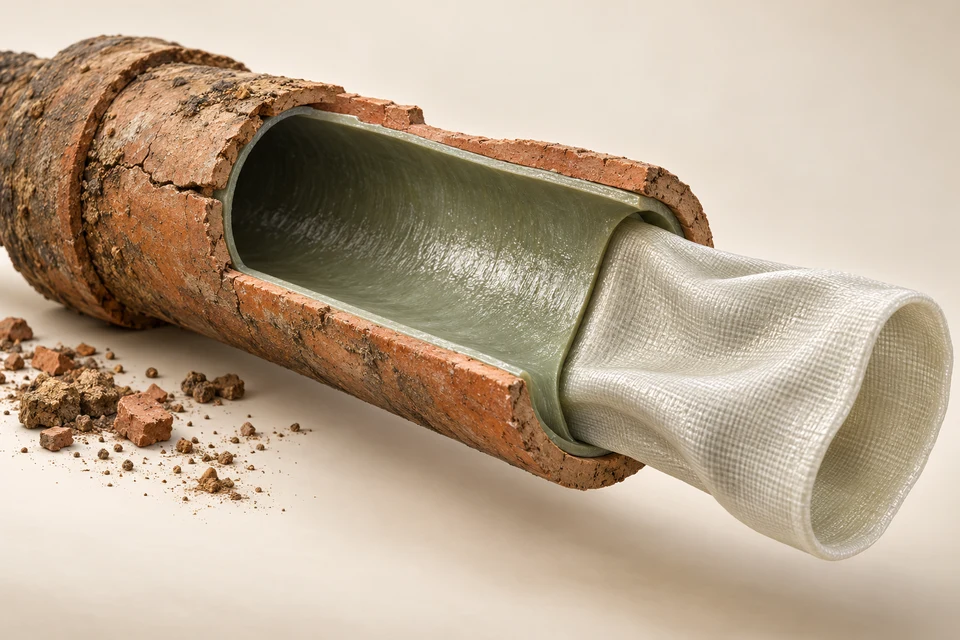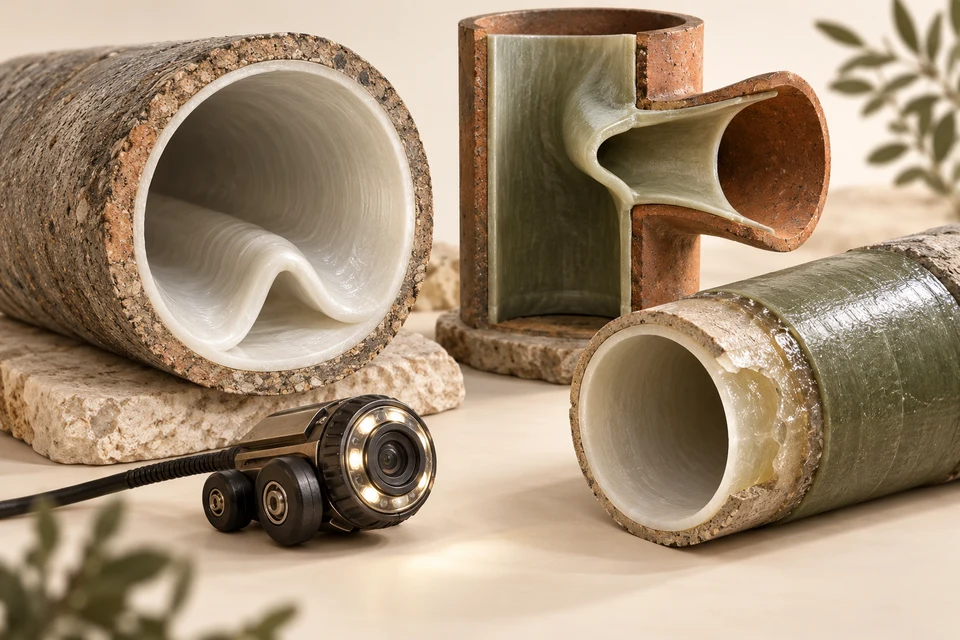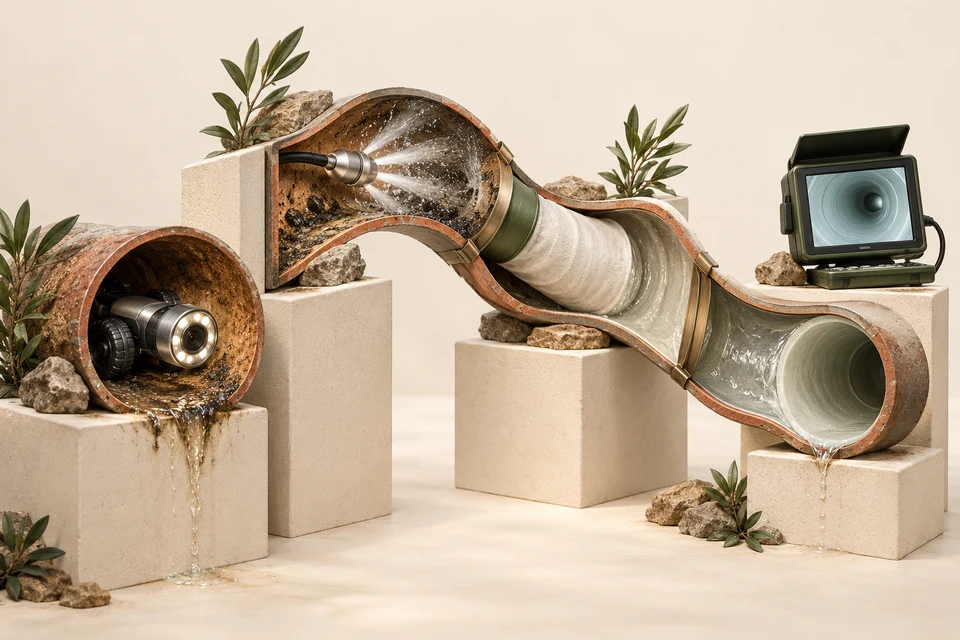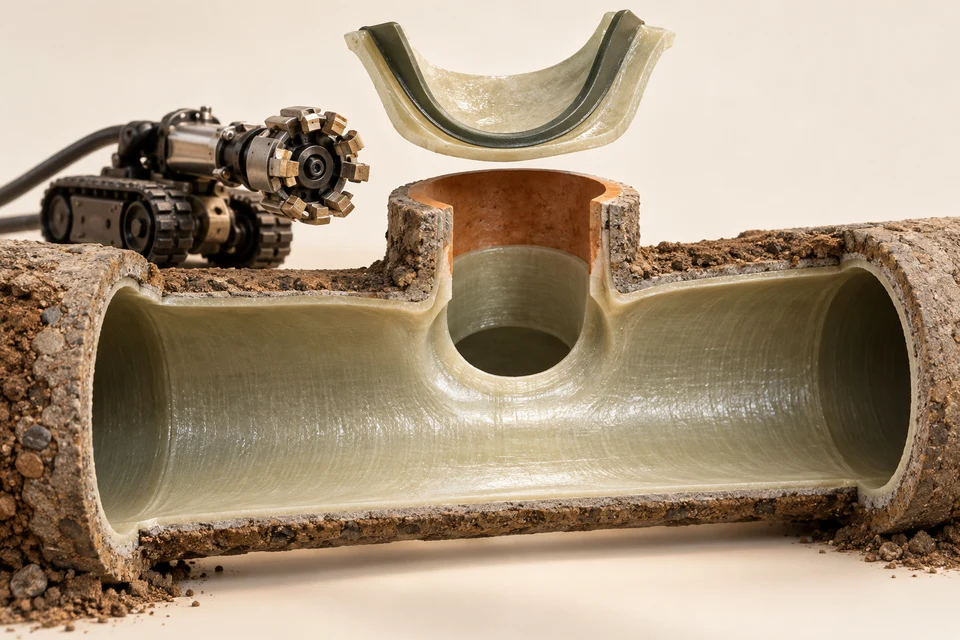
Reinstatement is reopening a branch or lateral connection that a new liner has covered, usually with a remote-controlled cutter working from inside the cured liner. A connection seal is a short liner or grout treatment that closes the junction afterwards, so water and roots cannot track between the liner and the old pipe. Both matter because the junction is the weakest point of an otherwise jointless lined pipe.
- A full liner covers every opening; each connection must be found, reopened and checked on video.
- A clean, full-sized cut matters: too small catches solids, too large weakens the liner and leaves an edge.
- Water can travel in the thin gap between liner and host pipe and leak out, or in, at connections and ends.
- Connection seals and grouting close that path; NASSCO stresses sealing lateral connections after lining.
- When a city lines its main, it reopens your lateral's connection; your own lateral is still yours to maintain.
01 /What does reinstatement mean in sewer lining?
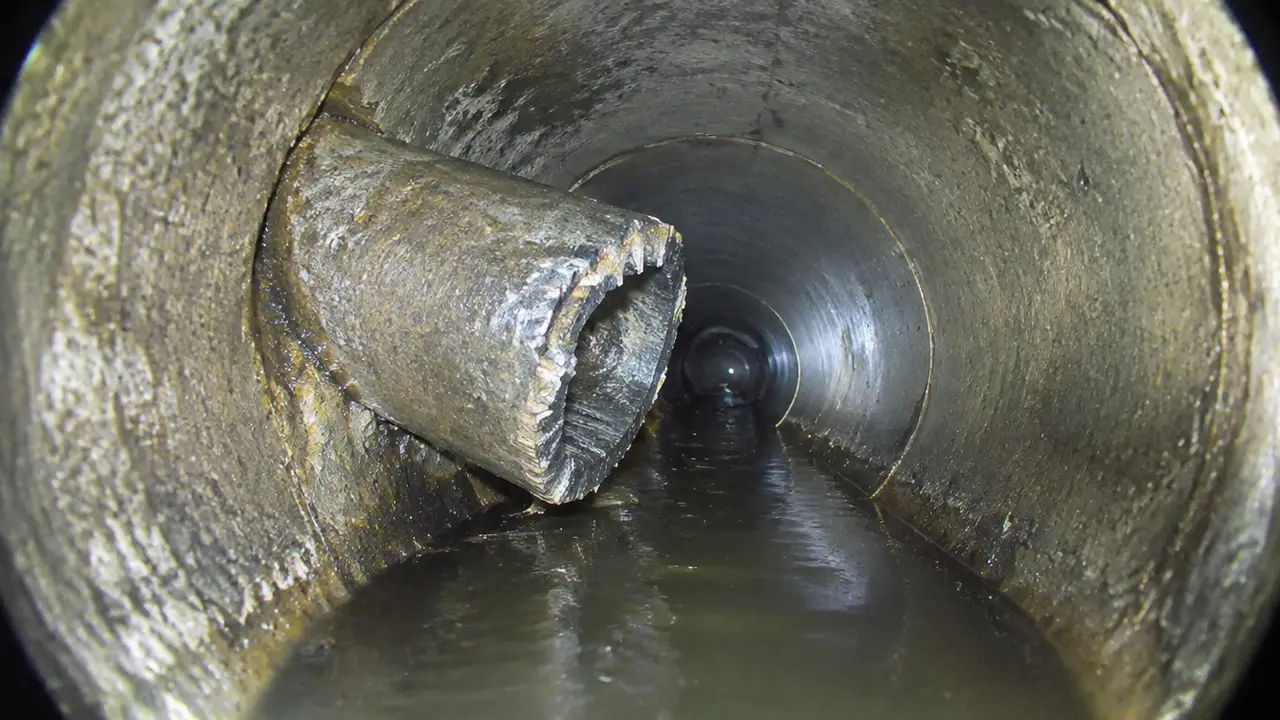
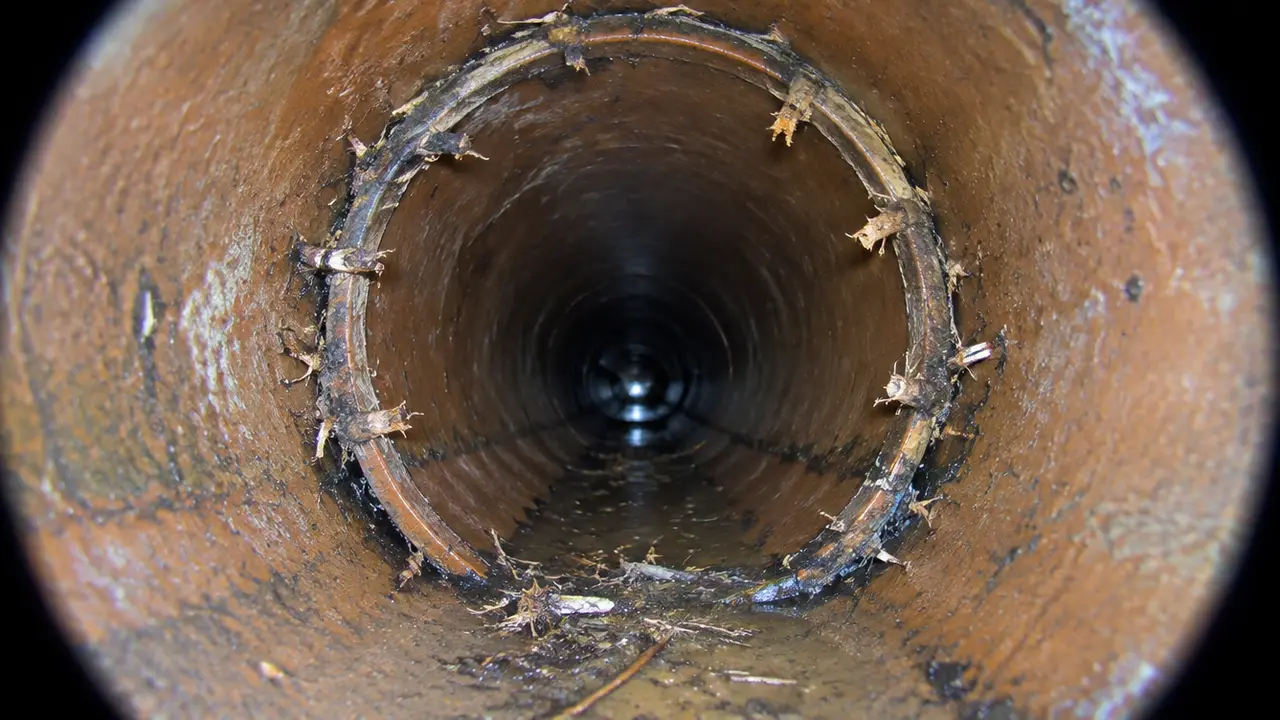
When a full-length liner is installed, it runs straight past every opening in the pipe wall. Where a branch joins, the soft liner bulges slightly into the opening before it cures, leaving a dimple. The US EPA's trenchless fact sheet describes exactly this: dimples appear where the laterals are, they are found by camera or robotic equipment, and the openings are typically reinstated with robotic cutting devices, or cut by hand in large-diameter pipe.
On a house lateral, the connections are usually few: perhaps a second building drain joining near the foundation, a branch from a garage or suite, or a wye fitting at a cleanout. Each one that the liner covers must be reopened before the household uses that drain again. Where the lateral is lined right to the main, the end at the main is finished too, which is often coordinated with the municipality.
02 /How is a covered connection found and reopened?
Before lining, every connection is logged by distance and clock position on the camera footage, so the crew knows where to look. After curing, a cutter, a small motorised grinding head on a steerable carriage with its own camera, is sent into the liner. The operator finds the dimple, confirms it against the pre-lining log, and grinds the opening out to the full size of the branch.
- Log every connection
Distance and position of each branch recorded on the pre-lining camera run.
- Line and cure
The liner covers all of them; drains on those branches are out of use.
- Find each dimple
The cutter's camera locates the bulge where the branch sits under the liner.
- Cut to full size
The opening is ground out cleanly to the branch's diameter, with smooth edges.
- Brush and inspect
Edges are finished and the reopened connection is recorded on video.
Two failures are common. An under-cut opening, smaller than the branch, leaves a lip that catches paper and grease and becomes a new blockage point. An over-cut one, or a cut in the wrong place, weakens the liner and can leave an edge that lets water behind it. Both are visible on the final video, which is why every reopened connection should be on it. More failure patterns are in problems with trenchless sewer repair.
03 /Why do lined pipes leak at connections and ends?
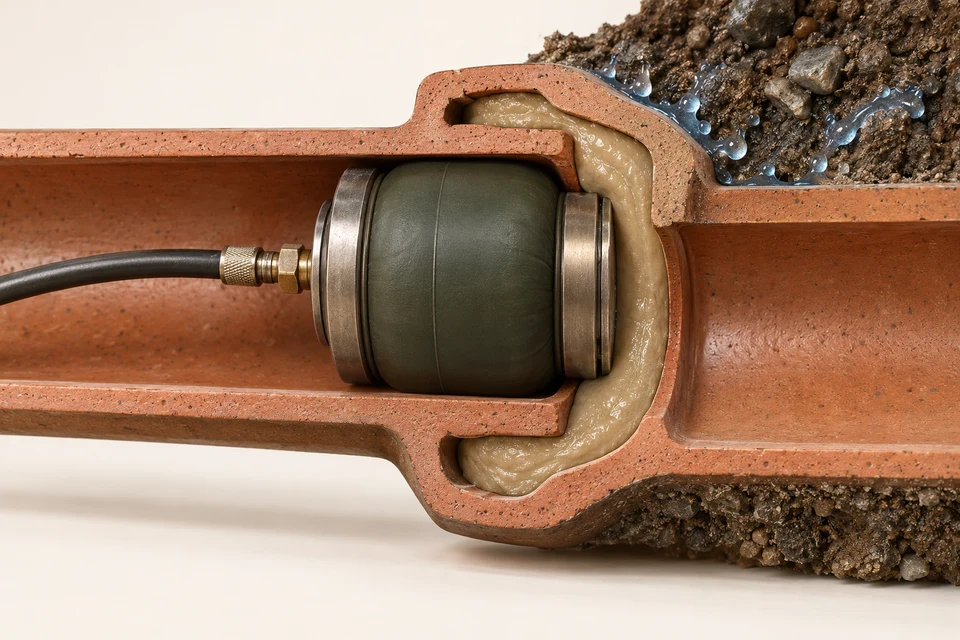
Because a liner, however well cured, is a pipe inside a pipe. If there is any gap between the two, and the resin does not bond fully to a wet or dirty host, water can travel along that thin space, called the annulus. NASSCO's guidance on grouting makes the point directly: water can flow between the annulus of the liner and the host pipe, and the pipe-to-manhole connections and lateral connections need to be sealed.
On a house lateral that means groundwater can enter behind the liner at a crack upstream and come out at a reopened connection or a liner end, or sewage can escape the same way outward. Roots follow water, so an unsealed junction can let roots return to exactly the place the liner was supposed to protect.
04 /What kinds of connection seals are there?
| Method | What it is | Where it fits |
|---|---|---|
| Connection liner (brimmed or top-hat style) | A short resin-soaked liner pressed into the branch, with a brim that laps onto the lined pipe | Branch connections where a durable, structural seal is wanted |
| End seals | Sealing bands or hydrophilic gaskets at the liner ends that swell in contact with water | Where the liner stops at the cleanout, property line or main |
| Junction grouting | A packer isolates the connection and injects grout into the ground around it | Where groundwater is getting in at the junction |
| Full lateral-to-main liner | One liner from the house through the connection with a brim at the main | When the municipality allows work at the main connection |
Product names and designs vary by manufacturer, and HAUSE does not rank them. What matters is that the quote names how every junction will be closed and that the final video shows it. The mechanics of lining itself are in when CIPP sewer lining fits, and grouting is covered in sewer joint grouting.
05 /What happens to my connection when the city lines its main?
When a municipality lines a sewer main, the liner covers the opening where your lateral joins, and the city's contractor reopens it. Some programs line the service connections as well. The City of Calgary, for example, runs a sanitary lateral lining program that sends equipment in from the manholes to line existing sanitary service pipes by a trenchless process. It asks residents to pour about four litres of water into every floor drain, laundry tub, bathtub and shower drain beforehand, not to run any water during the work, and it describes a connection closure of about three hours.
The EPA fact sheet notes a side effect of lining mains that matters to homeowners: groundwater that used to enter through the old main can be redirected to unlined side sewers, the laterals. In Calgary the City owns the service from the main to the property line, and its open data now records over 4,000 of those City-owned portions as CIPP. The private portion, from the property line to the house, stays the owner's to inspect and repair, and after a program like this it may be the oldest part of the line.
06 /What does reinstatement cost, and what should the quote say?
As a 2026 planning estimate, reinstating a branch connection inside a liner typically quotes about $300 to $1,200 each in Canada, and it appears as a separate line on a good lining quote. A connection with a seal installed may sit at the upper end, and complex or larger connections can cost more.
- The number of connections to be reopened, with their distances from the pre-lining video.
- How each is cut and how each is sealed afterwards.
- How the liner ends are finished and sealed.
- Final video showing every reopened connection from inside the liner.
- What happens if a connection is missed or under-cut after the crew leaves.
The Spot Repair or Full Liner? planner includes reinstatements in the full-liner price; sectional liners avoid them when the defects are away from connections. All line items are on the trenchless sewer repair cost page.
07 /How do I check a reinstatement on the final video?
Stop the video at each connection distance logged before lining. You are looking for an opening that is round, the full size of the branch, cleanly cut with no ragged fringe of liner, and with no gap, weeping or daylight around its edge. Water flowing from the branch into the liner should drop cleanly rather than pool at a lip.
If a connection looks wrong, raise it before the crew leaves; a cutter is far easier to bring back the same day. If you are reviewing footage after the fact, send it to the HAUSE Sewer desk for a second look. The whole job sequence, including where reinstatement fits, is in how trenchless sewer repair works.
FAQQuestions people ask
What is lateral reinstatement?
Reopening a branch or lateral connection that a new liner has covered, usually with a remote-controlled cutter working from inside the cured liner, then checking it on camera.
What is a top hat or connection seal?
A short liner pressed into a branch connection with a brim that laps onto the lined pipe, closing the junction so water and roots cannot get between liner and host.
Can a missed connection cause a backup?
Yes. A branch left covered by the liner has nowhere to drain, so the fixtures on it back up. Every connection should be logged before lining and checked after.
Why do roots come back after lining?
Usually at an unsealed junction or liner end, where water tracks between the liner and the old pipe. Sealing connections and ends closes that path.
Does the city reopen my connection when it lines the main?
Yes, its contractor reinstates the lateral connections. The private portion of your lateral remains yours to maintain.
NETWORKGo deeper across the HAUSE Sewer network
Sewer pipe lining cost: what a CIPP liner should cost in Canada
Sewer pipe lining cost in Canada (2026): CIPP liner ranges in CAD for full laterals and single sections, the line items, cost drivers and quality checks.
SewerRoots.caSewer lining for tree roots: will a CIPP liner stop them for good?
Sewer lining for tree roots: how a CIPP liner seals root-damaged joints, which lines qualify, preparation, weak points at the ends, and planning costs.
PipeCleaning.caWashing machine drain pipe: where it is, what size it is and how to clean it
Washing machine drain pipe guide: where the standpipe or laundry tub drain is, what size it should be, why it overflows, and how to clean out lint and scum.