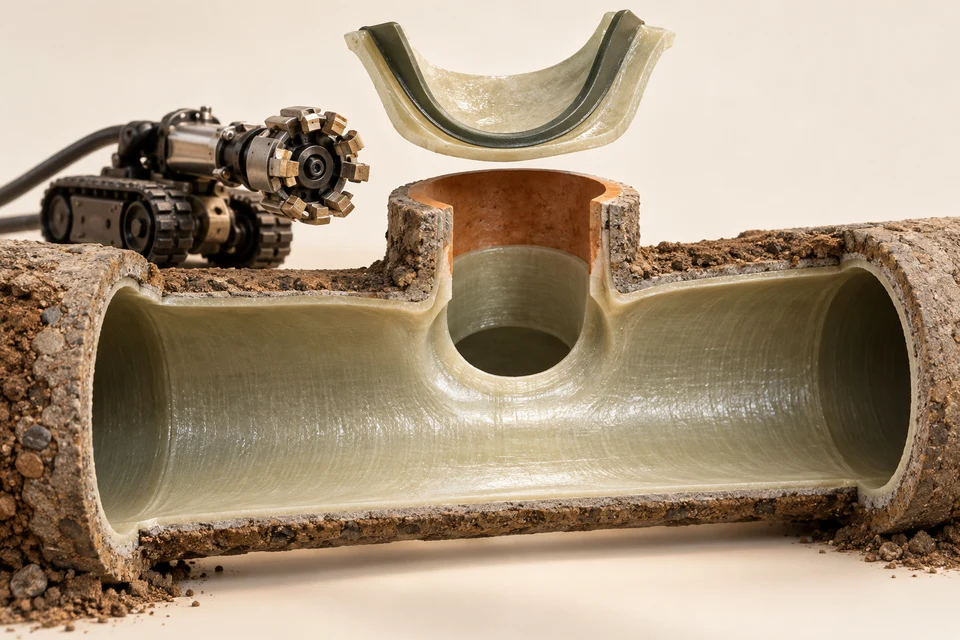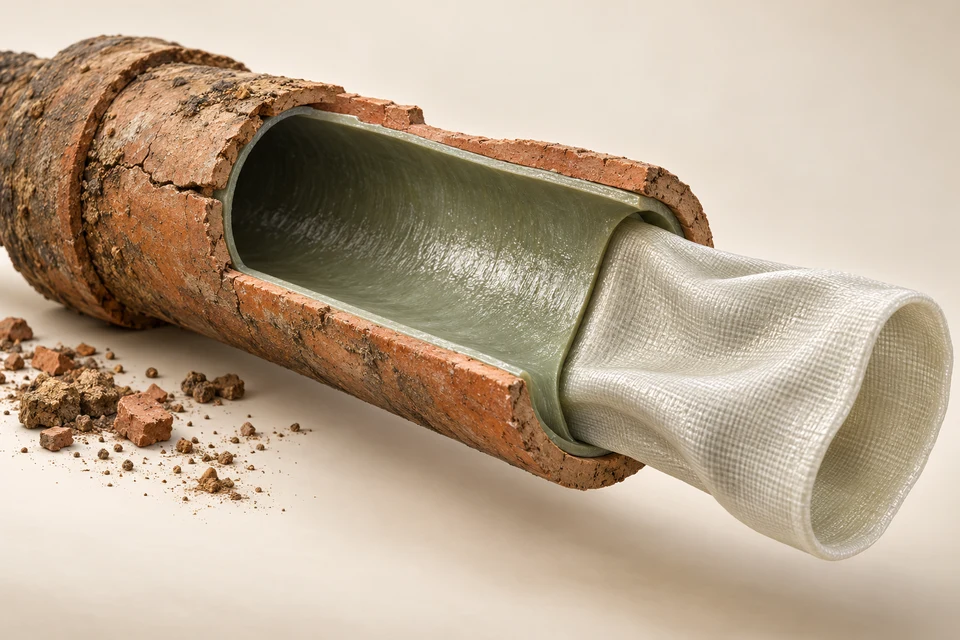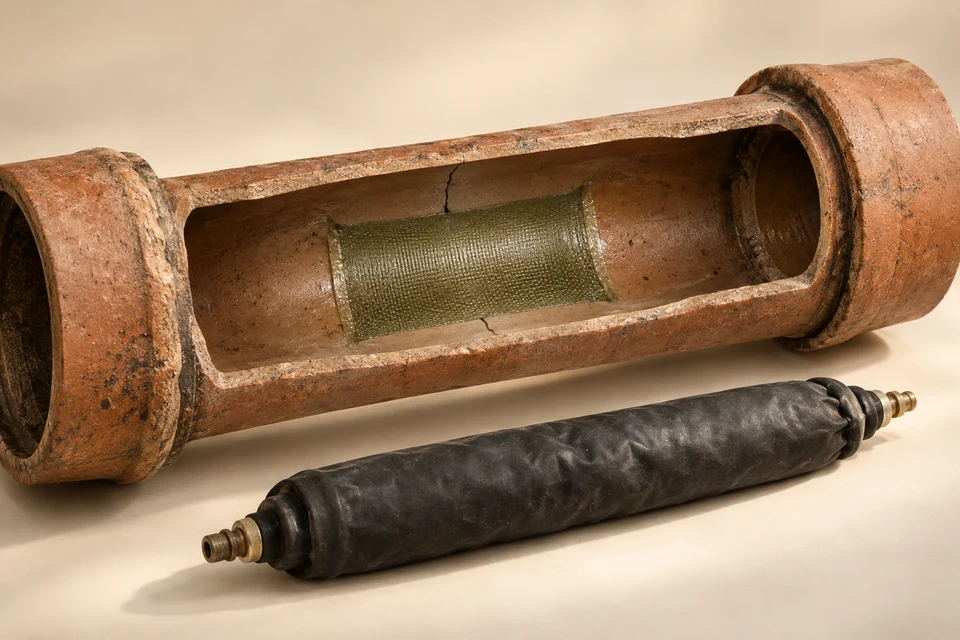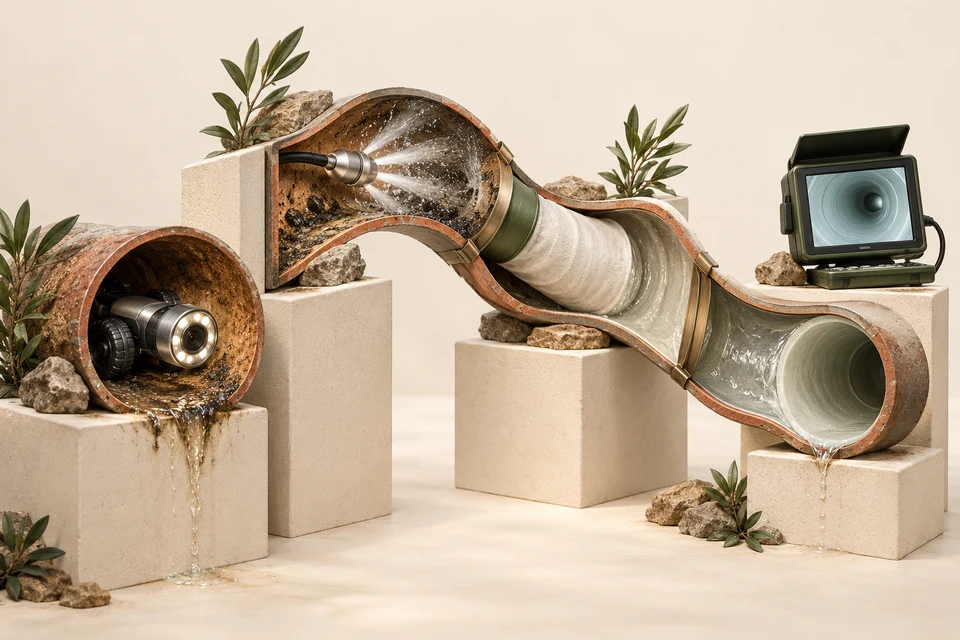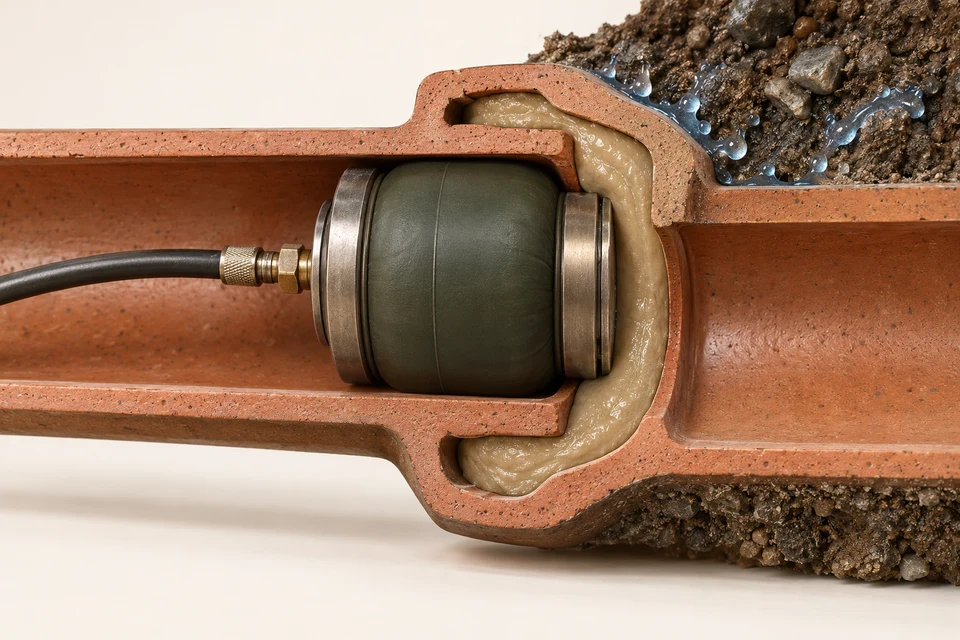
Joint grouting seals leaking joints in a sewer pipe that is otherwise structurally sound. A packer isolates one joint at a time, air-tests it, and if it leaks, injects chemical grout that flows through the gap and gels in the surrounding soil, forming a watertight collar. It stops infiltration and exfiltration at joints; it does not repair cracks, collapses or bellies, and it is not a structural repair.
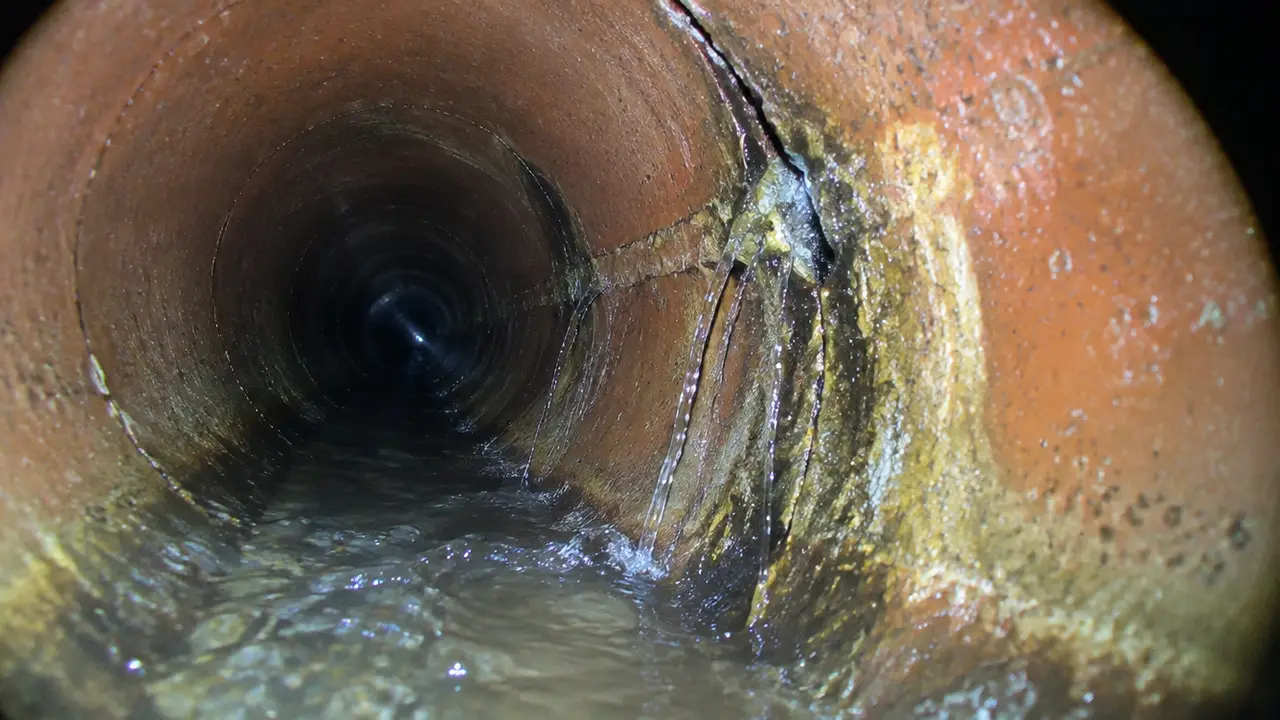
- Grouting is for joints that leak in pipe that is otherwise sound.
- The test-and-seal method checks each joint with air before and after grouting it.
- It is widely used on municipal mains and at connections, often before or after lining.
- It does not add strength: cracked, broken or deformed pipe needs a liner, bursting or a dig.
- Ask for a joint-by-joint record: which joints failed the test, how much grout each took, and the re-test.
01 /What is sewer joint grouting?
Chemical grouting is a way of sealing the joints of a gravity sewer from the inside without lining or digging. Two liquid components are pumped separately down a hose to a packer inside the pipe and mixed at the joint. The mixture is forced through the gap in the joint into the soil around the pipe, where it sets into a gel or foam that fills the voids and seals the joint from the outside.
ASTM F2304 is the standard practice for sealing sewers with chemical grouting, and NASSCO, the North American association of sewer rehabilitation contractors, publishes guidance and training on it. Grouting is common on municipal mains and manholes. On private house laterals it is less common than lining, but it has a real place where the problem is water getting in or out at joints rather than a pipe that is failing.
02 /How does test-and-seal grouting work?
- Clean and inspect
The line is cleaned and recorded on camera so every joint can be located.
- Position the packer
The packer is pulled or pushed to the first joint and centred on it using its camera.
- Isolate
Two inflatable end elements seal against the pipe either side, trapping a short void over the joint.
- Air test
The void is pressurised and watched; if pressure holds, the joint is sound and is left alone.
- Inject
If it leaks, grout is pumped into the void and out through the joint into the soil, where it gels.
- Re-test and move on
The joint is tested again; if it now holds, the packer moves to the next joint.
NASSCO's guidance puts the logic in one line: if a joint leaks air, it will leak water. It recommends air-testing and sealing every joint that is not airtight, and documenting each joint sealed, including the amount of grout injected. That record is what a homeowner or a municipality should ask to see.
03 /What does grouting fix, and what can it not fix?
Grout seals, it does not support. A cracked clay pipe that is losing its shape needs a liner to carry the load, or a burst or dig to replace it. A belly needs relaying. If your camera footage shows those defects, grouting is not the first conversation; see when CIPP sewer lining fits and trenchless sewer belly repair.
Roots and grouting have an awkward relationship. Roots are drawn to joints that leak, and a sealed joint gives them less reason to come; but roots already through a joint must be cut out before any grouting, and a joint torn open by root growth may no longer seal with grout alone. Ask the contractor what they expect on your particular joints.
04 /How long does grout last?
It depends on the grout, how it was mixed and applied, and the ground it sits in. NASSCO states that acrylamide grout, mixed and applied properly underground, can last 50 years or more at a 12 percent concentration, and cites a third-party study showing no desiccation over time. Those are the association's own claims about one grout type under proper conditions; other grouts, such as urethanes, behave differently, and soil that dries out repeatedly is harder on some gels than permanently damp ground.
For a homeowner, the practical protection is the same as for any repair: a named product, a written scope, a joint-by-joint test record and a final video, kept with the house file. Lifespan questions for all methods are gathered in how long trenchless sewer repair lasts.
05 /Where does grouting fit beside lining?
Often alongside it. NASSCO notes that injection grouting is frequently used before or after CIPP lining, because the liner seals the pipe itself while water can still travel in the thin space between liner and host and reach the connections and ends. Grouting the junctions closes that path. On municipal systems, crews may grout manholes and connections while lining the mains between them.
| Situation | Grouting | Sectional liner | Full liner |
|---|---|---|---|
| Sound pipe, a few leaking joints | Good fit | Possible | More than needed |
| Roots through one or two joints | After cutting, if joints are intact | Good fit | Possible |
| Roots or leaks at most joints of old clay | Many joints to treat | Many sections | Good fit |
| Cracked or fractured pipe | No | If isolated | Good fit |
| Leaks at a lined pipe's connection or end | Good fit | Connection liner | — |
The junction problem is covered in lateral reinstatement and connection seals, and the choice between short and full liners in sewer spot repair.
06 /What does joint grouting cost?
HAUSE does not publish a planning range for residential joint grouting, because it is priced very differently from job to job: per joint, per set-up, or as part of a larger lining contract, and it is offered by fewer residential contractors than lining. Confirm with contractors who do it, and ask for the price per joint tested and per joint sealed, so a line where most joints pass the air test is not charged as if every joint took grout.
Compare it with the known ranges: a sectional liner typically starts at $2,500 to $6,500 for the first section, and a full liner on a 15 to 25 m lateral runs about $9,000 to $28,000 as 2026 planning estimates. Those and every other line item are on the trenchless sewer repair cost page.
07 /What should I ask a contractor who proposes grouting?
- Why grouting rather than a liner for my footage?
- Which grout will you use, at what mix, and what does its manufacturer say about service life?
- Will every joint be air-tested, and will I get the result for each one?
- How much grout did each joint take, and did it pass the re-test?
- What happens to joints with roots or joints that will not seal?
- Will I get a final video, and what does the written warranty cover?
If the answers point back to structural problems, run the trenchless fit checker with what the camera found. If you are unsure whether grouting suits your line, send your footage to the HAUSE Sewer desk.
08 /Is grouting ever used on a house lateral in Calgary?
It is less common than lining on private laterals, but the conditions where it makes sense exist here as anywhere: sound pipe with a few leaking joints, or leaks at a lined pipe's connections and ends. Clay tile laterals from the 1960s and 1970s, common on the City side according to City open data, usually have roots at several joints by the time they are inspected, which tends to push the conversation toward a liner. Plastic laterals with a single leaking joint are more likely candidates. The Calgary guide has the local materials picture.
FAQQuestions people ask
What is test-and-seal sewer grouting?
A packer isolates one joint, air-tests it, and injects chemical grout only if it leaks, then re-tests it. The grout gels in the soil around the joint and seals it from outside.
Is chemical grouting a structural repair?
No. It seals leaking joints in pipe that is otherwise sound. Cracked, broken or deformed pipe needs a liner, bursting or excavation.
Can grouting stop tree roots?
It can seal the leaking joints roots are drawn to, once existing roots are cut out. Joints damaged by root growth may need a liner instead.
Can a house lateral be grouted?
Yes, with suitable packers, though it is less common than lining on private laterals. It suits a lateral with sound pipe and a few leaking joints.
Is grouting used with CIPP lining?
Often. NASSCO notes grouting is frequently used before or after lining, especially to seal connections and liner ends.
NETWORKGo deeper across the HAUSE Sewer network
Permanent fixes for roots in sewer lines
Permanent fixes for roots in sewer lines: CIPP lining, sectional point repairs, pipe bursting and open-cut replacement compared by cost, lifespan and fit.
SewerInspector.caCommon sewer defects, explained by what they do to the pipe
Common sewer defects explained: roots, cracks, fractures, offset and separated joints, sags, deposits, holes and collapse, with severity and usual next steps.
SewerQuotes.comTrenchless lining vs pipe bursting: cost, fit and trade-offs
Trenchless lining vs pipe bursting cost in Canada: 2026 CIPP and bursting ranges in CAD, line items, which defects each fixes and how to choose.